The sudden silence of a car radio is rarely a localized component failure; in the context of modern automotive engineering, it is often the canary in the coal mine for systemic electrical instability. Experts recognize that the infotainment system is a high-draw node on the vehicle’s power grid, making it sensitive to subtle fluctuations in voltage and signal noise. When you find that your car radio will not turn on, the diagnostic path must extend beyond the power button and into the complex interplay of the Controller Area Network (CAN bus) and the primary charging circuit. This failure often points to a hidden electrical drain that could eventually compromise your entire starting system if left unaddressed.
CAN Bus Communication Failures Often Silence Your Dashboard
In contemporary vehicles, the radio is not a simple analog device connected to a battery; it is a sophisticated electronic control unit (ECU) that communicates via digital protocols. According to the Society of Automotive Engineers (SAE), signal integrity within the vehicle network is paramount for all modular functions. If the radio does not receive a specific wake-up signal from the Body Control Module (BCM), it will remain in a dormant state even if raw voltage is present. Professional vehicle diagnostics are required to determine if a software handshake has failed or if a physical break in the data twisted pair has occurred. Technicians often see these communication errors manifested as intermittent power loss before a total blackout occurs.
Why Does Your Radio Stay Dark Only When the Engine is Cold?
Temperature-sensitive electrical failures are a hallmark of high-resistance connections. As copper wiring and solder joints contract in cold weather, a marginally failing connection can completely lose continuity. This is particularly common in the ignition switch circuit, which provides the accessory signal to the head unit. If the ignition switch is worn, it may fail to bridge the contact for the radio while still allowing the engine to turn over. This specific scenario highlights the necessity of expert auto repair techniques to isolate the switch as the culprit rather than the radio itself. Furthermore, if you notice that your car battery dies every time it rains, the moisture may be creating a temporary short in the antenna lead or external amplifier, triggering a safety shutoff in the head unit.
Diagnostic Workflows That Save Hundreds on Unnecessary Replacements
Before committing to a costly replacement, a systematic approach to power and ground must be undertaken. High-end diagnostic tools can monitor the voltage drop across fuses under load, revealing parasitic draws that a simple visual inspection would miss. It is not uncommon for a faulty amplifier or a stuck CD changer mechanism to pull just enough current to lower the system voltage below the radio’s operational threshold during startup. For those looking to troubleshoot at home, learning how to identify a bad ground wire without a multimeter can save significant time and money. A loose ground at the chassis can cause the radio to cycle on and off or refuse to boot entirely due to the lack of a stable return path for current. If your vehicle shows other signs of electrical distress, such as flickering lights or sluggish shifting, consider exploring our deep dive into transmission failures decoded to ensure your primary control systems remain intact.
Are You Ready to Solve Your Electrical Mysteries?
Don’t let a silent dashboard escalate into a dead battery; professional intervention can pinpoint the root cause of electrical anomalies before they lead to a breakdown. Explore our latest technical guides or contact our expert team for a comprehensive electrical system health check today.
When a car radio refuses to respond, many drivers immediately assume the hardware has reached its end of life. However, modern head units are deeply integrated into the vehicle’s security infrastructure. A common yet frequently overlooked cause is the anti-theft lockout mechanism. If the battery was recently disconnected or suffered a significant voltage drop, the radio may enter a secure mode that looks exactly like a total power failure. Before pulling the dashboard apart, check your owner’s manual for a security code. This protocol is designed to deter theft, but in an aging electrical system, it can be triggered by a hidden ground wire that causes momentary power interruptions during heavy engine load.
Stop Chasing Fuses When Anti-Theft Lockouts Are the Real Culprit
In high-fidelity systems, the radio often serves as the master controller for various vehicle settings. If the unit remains black, the issue might not be the radio itself but a downstream component failure. Many premium audio systems utilize an external power amplifier hidden in the trunk or under a seat. If this amplifier suffers a short circuit or a blown fuse, the head unit may refuse to boot as a protective measure. This is a failsafe designed to prevent a thermal event within the dashboard. If you suspect your power delivery is inconsistent, you can perform a quick assessment of your electrical health by learning how to test your car battery with a simple headlight trick. If the lights dim significantly under load, your radio’s failure is likely a symptom of an overtaxed alternator or a dying cell.
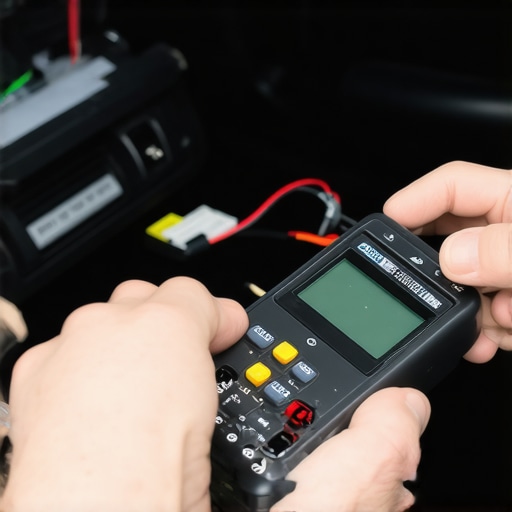
Could an Overheated Amplifier Be Muting Your Morning Commute?
Thermal protection is a critical feature of automotive grade semiconductors. When internal temperatures exceed safe operating limits—often due to poor ventilation behind the dash or a failing internal cooling fan—the microprocessor will initiate a hard shutdown. This is why a radio might work perfectly for ten minutes and then suddenly go dark. According to technical data from the Bosch Automotive Handbook, electronic components in the dashboard must withstand temperatures up to 85°C (185°F), but as dust accumulates in the chassis, heat dissipation becomes impossible. If your radio only fails during long drives, it is likely a heat-soak issue rather than a wiring fault. This logic also applies to other cabin electronics; for instance, if you have ever wondered why your dashboard lights flicker every time you hit a pothole, it is often a sign of physical vibration compromising a heat-weakened solder joint.
The Hidden Link Between Battery Health and Digital Brick Scenarios
Firmware corruption is the newest frontier in automotive repair. Modern vehicles receive over-the-air updates or rely on SD cards for navigation data. If a write-cycle is interrupted by a weak battery during startup, the operating system of the head unit can become corrupted, leading to a perpetual black screen or a loop at the manufacturer’s logo. This “bricking” of the hardware is often misdiagnosed as a physical failure. In these cases, a hard reset—achieved by disconnecting the negative battery terminal for thirty minutes—can occasionally force a reboot. However, if the underlying power issue remains, the corruption will return. To ensure your vehicle’s computer systems are receiving stable current, consider a professional evaluation of your charging circuit. If you have found these technical insights helpful, share this guide with a fellow car enthusiast or leave a comment below describing the specific symptoms your vehicle is exhibiting so our community of experts can offer more targeted advice.
Why Vibration and Harness Routing Kill Modern Infotainment
While electronic glitches often steal the spotlight, the physical path that power takes through your vehicle is prone to mechanical degradation. Modern automotive wiring harnesses are masterpieces of packaging, but they are increasingly composed of thinner, higher-gauge wires to reduce weight and cost. Over thousands of miles, the constant vibration of the engine and the impact of road surface irregularities can cause these harnesses to rub against sharp metal brackets behind the dashboard. This abrasion eventually breaches the insulation, leading to intermittent ‘soft shorts’ that can disable the radio without necessarily blowing a primary fuse. If you have noticed your audio cutting out only when driving over rough pavement, the issue is likely a physical breach in the harness integrity rather than a software bug.
A specific area of concern is the kick panel wiring, where moisture from wet boots or spilled drinks can seep into connectors. Even a microscopic amount of liquid can initiate capillary action, pulling contaminants deep into the wiring harness. This leads to a phenomenon known as wicking, which can transport corrosive elements directly into the pins of the head unit’s primary connector. According to the Auto Care Association, electrical system failures due to environmental contamination are among the top causes for modular component replacement in vehicles over five years old. Identifying these breaches early can prevent the total loss of the infotainment unit.
Can a blown fuse in a different circuit stop the radio from working?
The architecture of a car’s fuse box is rarely as straightforward as the labels suggest. Engineers often bridge multiple low-current components onto a single circuit to maximize efficiency. For instance, it is remarkably common for a car radio to share a power source with the interior dome lights, the vanity mirror illumination, or even the diagnostic OBD-II port. If you accidentally short out a cigarette lighter or a light bulb while performing a minor repair, the radio might go dark as a collateral consequence. This cross-talk in the electrical distribution block means that a comprehensive diagnostic must include testing fuses that seemingly have nothing to do with audio. If you are struggling to map out these connections, our guide on identifying bad grounds provides a baseline for understanding how these circuits return to the battery.
Combatting Invisible Oxidation on Micro-Terminal Connectors
Even if your wiring remains intact, the microscopic interface where the harness meets the radio can fail through a process called fretting corrosion. This occurs when tiny, vibration-induced movements at the contact point wear away the protective plating on the pins, exposing the underlying base metal to oxygen. The resulting oxidation layer acts as an insulator, blocking the low-voltage signals required for the radio to boot. Technicians often resolve this failure by simply unplugging and replugging the connectors—a process that physically scrapes away the oxidation—but this is a temporary fix. For a permanent solution, the application of a high-quality dielectric grease or a specialized contact cleaner is required to seal the connection from the atmosphere. Ignoring these subtle signs of resistance can lead to permanent damage to the radio’s internal power stage.
As vehicle systems become more integrated, the radio is no longer just for entertainment; it is the visual interface for your backup camera and advanced driver assistance systems (ADAS). When the screen goes dark, you lose more than just music—you lose critical safety data. Before you decide to pull the unit out for a bench test, take a moment to inspect the health of your primary battery terminals. A thin film of lead sulfate on the battery posts can create enough resistance to starve high-draw electronics while still providing enough juice for the dash lights. If you are unsure about the state of your power supply, we recommend checking out our analysis of moisture-related battery drain to see if environmental factors are sabotaging your system’s stability. Beyond the battery, the next logical step in the diagnostic chain involves measuring the specific pin-out voltages at the head unit’s main harness while the vehicle is under various load conditions, a process that requires
specialized knowledge of oscilloscope waveforms. In luxury marques like Audi or BMW, the head unit is merely one node in a Media Oriented Systems Transport (MOST) network. Unlike traditional copper-wired systems, these use fiber optic cables to transmit data. If a peripheral module, such as the voice control or the satellite radio tuner, loses power or suffers a physical break in the optical fiber, the entire ring fails. To the driver, this appears as a dead radio, but the fault often lies in the trunk, where a minor leak might have corroded the satellite module’s pins. Finding the ‘break in the light’ requires a bypass loop tool to isolate which component is obstructing the signal.
Restore the Light to Fix a Broken MOST Bus
Many modern drivers unknowingly sabotage their own audio systems by installing low-quality LED headlight conversions. These bulbs often lack the necessary shielding to prevent pulse-width modulation (PWM) noise from leaking into the vehicle’s wiring harness. This radio-frequency interference (RFI) can be so intense that it ‘blinds’ the head unit’s tuner or disrupts the digital handshake between the radio and the instrument cluster. If your radio display flickers or resets only when your lights are on, the culprit isn’t the radio—it’s the electromagnetic ‘pollution’ from your lighting upgrade. High-end automotive engineering requires specific shielding standards, as defined by the Institute of Electrical and Electronics Engineers (IEEE), which many budget-grade components simply ignore.
Could a Depleted Telematics Battery Be Crashing the Entire Head Unit?
Many drivers are unaware that their vehicle contains a secondary, hidden battery dedicated to emergency telematics. These lithium-ion cells power the GPS and cellular communication modules that activate during an accident. When this internal battery reaches the end of its five-to-seven-year lifespan, it can create a parasitic load or trigger a software error that prevents the infotainment system from completing its boot cycle. Professional technical bulletins from Delphi Technologies suggest that these integrated backup systems are becoming a frequent culprit in otherwise ‘unsolvable’ electrical blackouts. Replacing the main vehicle battery won’t fix this; you must address the internal telematics cell to restore functionality.
Guard Your Hardware Against Cranking-Induced Voltage Transients
The moment you turn the key, the starter motor creates a massive electromagnetic field and a subsequent ‘load dump’ when it disengages. While automotive-grade microchips are designed to handle these transients, the aging capacitors inside an older head unit lose their ability to filter this noise. Over time, these spikes can cause ‘latch-up’—a state where the radio’s processor locks itself to prevent permanent damage. If your radio only turns on after you’ve driven for a few miles and restarted the car, you are likely dealing with a power-conditioning failure. This instability is often exacerbated by poor-quality aftermarket accessories, like cheap USB chargers that bleed high-frequency noise into the 12V rail.
Check our detailed guide on advanced electrical diagnostics to see how we tackle these high-level system failures. If you suspect your radio is trapped in a protective lockout, reach out to our diagnostic specialists for a deep-dive scan of your vehicle’s communication architecture.
Expert Insights & Advanced Considerations
Voltage Sag During Cranking Might Be Your Real Enemy
Many modern head units have a low-voltage cutoff to protect internal flash memory. If your battery’s resting voltage is fine but drops below 9.5V during startup, the radio’s logic board may enter a safe mode or refuse to initialize to prevent data corruption. This scenario is often linked to a hidden electrical drain that weakens the battery over time without being caught by basic tests.
The Silent Handshake That Makes or Breaks Your Audio
It is not just about 12V and Ground anymore. If the digital handshake between the Body Control Module and the infotainment node is jittery due to electromagnetic interference, the radio will stay dark. This often happens after installing cheap LED interior lights that lack proper RFI shielding. Professional vehicle diagnostics can reveal these communication gaps that a standard multimeter cannot detect.
Don’t Assume Hardware Failure Before Checking Your Security Codes
Anti-theft protocols can mimic a total hardware blackout. If your car suffered a deep discharge, the radio might be waiting for a security input that does not trigger a visual prompt on a dead screen. Before you replace the unit, verify that a bad ground wire has not triggered a security lockout by causing micro-interruptions in the constant power line during heavy engine load.
#IMAGE_PLACEHOLDER_E#
Curated Expert Resources
The Bosch Automotive Handbook: This is the industry gold standard for understanding signal protocols, thermal tolerances, and electrical architecture in modern vehicles.
ALLDATA Repair Databases: Accessing these provides the specific wiring diagrams needed to trace hidden fuses or shared circuits that are often skipped in basic owner manuals.
Society of Automotive Engineers (SAE) Technical Papers: These are invaluable for those wanting to dive deep into MOST bus fiber optic architecture and network topology used in luxury marques.
Final Expert Perspective
Troubleshooting why your car radio will not turn on requires moving from simple fuse-pulling to a systemic analysis of power delivery and network communication. Whether it is a physical wiring breach or a corrupted firmware loop, the solution lies in precision. If your electrical mysteries persist, contact our expert team to regain control of your cabin electronics and ensure your vehicle integrated systems remain stable. For more tips on maintaining your vehicle system, explore our expert auto repair tips for 2025.