The Silent Logic of Modern Cabin Illumination
Modern vehicles have transitioned from simple physical switches to complex, logic-gated systems where the interior lights are managed by the Body Control Module (BCM). When these lights refuse to extinguish, the root cause often transcends a simple ‘on’ position. We are usually dealing with a failed sensor feedback loop or a software-level ‘keep-awake’ command. This persistent illumination is more than an annoyance; it is a primary driver of parasitic battery drain that can leave you stranded. Understanding the hierarchy of these electrical circuits is essential for any high-level vehicle diagnostics protocol.
Mechanical Gremlins in the Door Jamb Latch
In the era of ‘theater dimming,’ the door switch is no longer a simple plunger in the frame. Most manufacturers have moved the switch inside the door latch assembly. Over time, road grime and degraded lubricants can cause these micro-switches to stick in the ‘open’ position. Even if the door is physically closed, the electrical signal remains ungrounded, telling the BCM the door is still ajar. Before assuming a major failure, a professional technician often employs specialized lubricants to clear the latch mechanism—a simple move that saves hours in auto repair labor costs.
Why Does Your Car Alarm Go Off Randomly When the Lights Won’t Dim?
There is a direct correlation between lighting malfunctions and security system triggers. If the BCM perceives a door as open due to a faulty sensor, it may trigger the perimeter alarm when the system is armed. This is particularly common in older luxury vehicles where the wiring harnesses in the door hinge accordion boots become brittle and short-circuit. If you are experiencing this double-trouble, you might want to investigate why your car alarm goes off for no reason at night to see if the two symptoms share a common ground wire failure.
The BCM and the ‘Keep Awake’ Protocol
The Body Control Module is the brain of your cabin. It monitors everything from seatbelt pretensioners to window regulators. According to technical standards established by organizations like the Society of Automotive Engineers (SAE), these modules must enter a ‘sleep mode’ to conserve power. However, a malfunctioning accessory, such as a stuck vanity mirror switch or a faulty ignition cylinder, can keep the BCM on high alert. This prevents the ‘time-out’ function that would normally kill the interior lights after 10 to 20 minutes. Identifying which module is ‘talking’ on the CAN-bus requires advanced diagnostic scan tools that can see beyond standard OBD-II codes.
If you find yourself constantly jumping your car due to lighting issues, it is time to stop the guesswork. Our experts can help you isolate the exact circuit causing the bleed. Schedule a professional electrical audit today to protect your battery and alternator from premature failure.
The Simplest Culprit Is Often Hiding in Plain Sight
Before dismantling the dashboard or investigating complex wiring looms, start with the most basic mechanical interface: the instrument panel dimmer switch. On many domestic and older import models, rotating the interior light dimmer to its maximum limit engages a physical ‘click’ that overrides all automatic logic. It is surprisingly common for a driver or a passenger to accidentally bump this wheel while cleaning the interior or reaching for the turn signal. If this switch is engaged, the Body Control Module (BCM) assumes you want the lights on indefinitely, bypassing the standard shut-off timer. Verifying this manual override is a foundational step in any reliable car service routine.
When Corroded Grounds Force Electricity Backwards
Electrical current is like water; it follows the path of least resistance. If a primary ground point for the interior lighting circuit becomes corroded or loose, the electricity may ‘back-feed’ through other components to find a path to the chassis. This phenomenon can keep relays energized even when the BCM has attempted to cut the primary signal. Learning how to spot a bad ground wire is vital because a weak connection at the A-pillar or under the dash can cause the dome light to stay dimly lit or fully bright, leading to a frustrating search for a ‘short’ that doesn’t actually exist.
Could Your High-Efficiency LED Bulbs Be To Blame?
Upgrading to LEDs is a popular way to modernize a cabin, but it often introduces unforeseen logic errors in late-model vehicles. Standard incandescent bulbs provide a specific amount of resistance that the BCM uses to verify circuit integrity. LEDs, which pull significantly less current, can cause the BCM to detect an ‘open circuit’ or a circuit fault. In some advanced European systems, the module may keep a small amount of ‘keep-alive’ voltage on the line to monitor for bulb presence. While an incandescent bulb wouldn’t glow from this tiny current, a high-sensitivity LED might stay partially illuminated. If your lighting issues started right after a cosmetic upgrade, you are likely dealing with a resistance mismatch that requires a CAN-bus-ready bulb or a load resistor to satisfy the module’s diagnostic parameters.
The Invisible Drain of Faulty Accessory Switches
Another frequent, yet hidden, culprit is the vanity mirror light located in the sun visor. The hinges on these mirrors are prone to fatigue, causing the internal micro-switch to stay in the ‘on’ position even when the cover is closed. Because the visor is usually flipped up against the headliner, the light remains hidden from view, silently draining the battery while the vehicle is parked. This is a classic example of why expert auto repair tips for 2025 emphasize checking the mechanical integrity of every interior accessory before assuming a software failure has occurred.
Tracing Parasitic Draws in the Connectivity Era
Modern vehicles are increasingly interconnected, and a single module failing to ‘go to sleep’ can keep the entire interior illumination network powered up. According to technical diagnostic data from Mitchell 1 ProDemand, a failure in the rear liftgate glass sensor or even a faulty trailer hitch wiring harness can keep the vehicle’s data bus active. This prevents the BCM from entering its low-power state. If you find that your battery dies every three days, it is a clear sign that the ‘time-out’ logic has been interrupted. Have you noticed your lights flickering or staying on after a recent repair? Let us know in the comments, or suggest a topic you would like us to deconstruct next to help you keep your vehicle in peak condition.
The Ghost in the Hatch That Keeps the BCM Awake
In many modern SUVs and hatchbacks, the rear liftgate uses a dual-stage latching mechanism that communicates specifically with the interior lighting logic. A common point of failure is the ‘glass-ajar’ sensor. Unlike the main hatch, the rear glass often has its own dedicated micro-switch. If this switch is misaligned or the striker has shifted by even a few millimeters, the Body Control Module (BCM) receives a constant signal that the vehicle is unsecured. This doesn’t just keep the dome lights on; it forces the vehicle’s high-speed GMLAN or CAN-bus to remain in an ‘active’ state, preventing the entire car from entering deep sleep. Technicians utilizing data from ALLDATA often find that these hatch sensors are the primary culprits in cases where the dashboard indicates all doors are closed, yet the interior illumination persists. Verifying the physical alignment of these rear latches is an essential step in any advanced vehicle diagnostics procedure.
Can a Worn Ignition Cylinder Stop Your Lights from Dimming?
Many drivers are surprised to learn that the ignition lock cylinder plays a critical role in the cabin lighting circuit. Most vehicles manufactured in the last two decades feature a ‘key-in’ reminder switch. This tiny mechanical contact inside the cylinder tells the BCM when a key is physically present. Over years of use, the internal springs can weaken or heavy keychains can deform the tumblers, causing the switch to stick. Even after you pull the key out and lock the doors, the car ‘thinks’ you are still sitting in the driver’s seat. Because the logic is designed to keep the lights on for safety until the occupant exits and locks the vehicle, this faulty sensor effectively overrides the auto-off timer. If you can wiggle your ignition cylinder and see the lights flicker, you’ve found a mechanical failure that no software update can fix.
Why Your Insurance Tracking Dongle is a Battery Killer
The rise of telematics—those small devices provided by insurance companies that plug into your OBD-II port—has introduced a new variable into the electrical drain equation. These devices require a constant 12V feed to transmit data. However, if the device is poorly programmed or incompatible with your vehicle’s specific firmware, it can ‘ping’ the BCM or the Gateway Module too frequently. This constant digital chatter prevents the vehicle from ‘timing out’ its accessory power. We have seen instances where removing a simple Bluetooth scanner or an insurance tracker immediately allowed the interior lights to follow their normal dimming curve. If you’re chasing a parasitic battery drain, always start by unplugging everything from the diagnostic ports and 12V outlets.

Clogged Sunroof Drains and the Short Circuits They Create
One of the most insidious causes of lighting malfunctions is moisture ingress. High-end vehicles often route their sunroof drain tubes down the A-pillars, directly past the primary fuse box and BCM location. If these tubes become clogged with organic debris, water backs up and leaks onto the electrical connectors. This moisture creates high-resistance ‘bridges’ between pins in the wiring harness. This isn’t a direct short that pops a fuse, but rather a ‘soft’ short that provides just enough voltage to energize a relay or trick a sensor into thinking a door is open. Tracing this requires a meticulous inspection for green oxidation on the pins—a hallmark of water damage. This is a prime example of why auto repair for electrical issues must often start with a search for physical leaks. If you suspect moisture is the culprit, our team can perform a deep-dive electrical audit to save your modules from permanent corrosion.
Identifying High-Resistance Faults in the Ceiling Harness
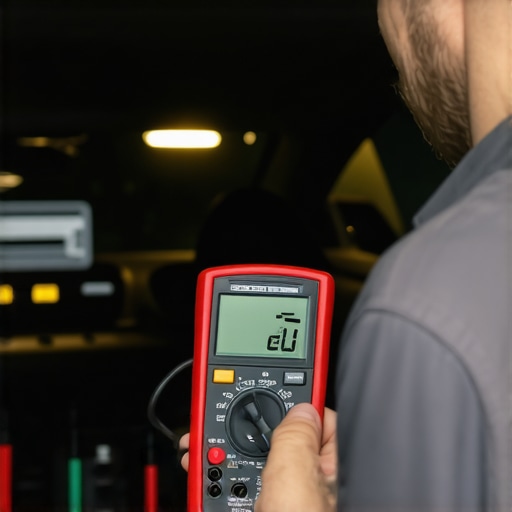
The wiring that runs through the headliner to power dome lights and vanity mirrors is often thinner and more fragile than the main chassis harness. Because this area is subject to extreme temperature fluctuations—ranging from freezing winter nights to blistering summer heat—the insulation can become brittle. A small crack in the wire insulation can cause a low-level leak of current to the metal roof skin. This creates a fascinating but frustrating scenario where the lights might stay dimly lit even when the car is off, as the current finds a weak path to ground through the vehicle’s body. Testing for this requires a digital multimeter to check for ‘voltage drop’ across the circuit, a technique used by ASE-certified master technicians to find faults that standard diagnostic tools might miss.
Beyond the Wiring: Why a Software Reflash Might Be Your Only Cure
Sometimes, the hardware is perfect, but the instructions are flawed. Many modern vehicles suffer from software glitches within the Body Control Module (BCM) that prevent the ‘power-down’ command from executing after the ignition is killed. According to official records in the National Highway Traffic Safety Administration (NHTSA) database, several manufacturers have issued Technical Service Bulletins (TSBs) specifically for interior lights that stay on, requiring a firmware ‘reflash’ rather than a physical parts replacement. This highlights why high-level vehicle diagnostics must include a check for pending manufacturer software updates before any intrusive physical teardown begins. These updates often recalibrate sensor thresholds, ensuring the BCM doesn’t misinterpret a tiny voltage spike as a command to keep the cabin illuminated.
Can a Leaking Alternator Diode Confuse Your Body Control Module?
It sounds counterintuitive, but a failing alternator can be the ‘ghost’ in your electrical system that keeps the lights on long after you’ve left the car. If one of the diodes in the alternator’s rectifier bridge fails, it can allow a small amount of Alternating Current (AC) to ‘leak’ into the vehicle’s Direct Current (DC) system. This AC ripple creates ‘noise’ on the vehicle’s communication bus, which can scramble the data packets sent between door sensors and the lighting controller. If your interior lights stay on and you notice a faint hum through your speakers or a slight flicker in the dashboard display, you aren’t just dealing with a lighting issue; you are facing a potential parasitic battery drain rooted in the charging system’s internal health.
The Hidden Failure of Theater Dimming Transistors
The smooth ‘fade-to-black’ effect in modern luxury cabins isn’t controlled by a simple mechanical relay, but by a MOSFET—a high-speed transistor located on the BCM circuit board. These electronic components manage the gradual voltage ramp-down. However, transistors are highly susceptible to heat damage and internal ‘punch-through’ shorts. If the MOSFET fails in a closed state, it essentially creates a permanent electronic bridge for current, bypassing all software commands to extinguish the lamps. Diagnosing this requires a technician to perform a ‘voltage drop test’ across the internal pins of the module, a sophisticated step that separates amateur hobbyists from professional auto repair experts who understand board-level troubleshooting.

When Aftermarket Remote Starters Break the Digital Handshake
Convenience often comes with a hidden cost to your vehicle’s electrical logic. Aftermarket remote start systems frequently ‘tap’ into factory door-pin wires or the CAN-bus network to monitor the vehicle’s security status. If the bypass module or the wiring harness for the remote starter degrades—often due to poor installation—it can send a false ‘ground’ signal to the BCM. This tricks the car into thinking a door has been opened or that a passenger is still inside, even while the vehicle is locked and armed. If your lighting gremlins appeared months after an accessory installation, the conflict likely lies in this broken digital handshake. Don’t let a faulty accessory kill your new battery—connect with our electrical specialists to decouple these conflicting systems and restore your vehicle’s original factory logic through a comprehensive system audit.
Expert Insights & Advanced Considerations
Thermal Imaging Solves Parasitic Drains Faster
While a standard multimeter is great for finding the hidden electrical drain killing your battery, professional technicians often use thermal cameras to identify the exact source. If a Body Control Module (BCM) or a transistor is active when the car should be asleep, it generates a heat signature. Seeing this thermal footprint allows for an instant diagnosis without the need to dismantle the entire interior to find a stuck relay.
Don’t Forget the Ignition Cylinder Switch
One of the most overlooked mechanical failures involves the physical ignition lock. If the internal ‘key-in’ sensor sticks, the BCM assumes the driver is still present and refuses to cut the accessory power, keeping the cabin illuminated. Before assuming you have a complex software glitch, check if your car chimes when you open the door with the key removed; if it does, the ignition is likely keeping your lights on.
Filter Out the AC Ripple Noise
If you have recently installed an aftermarket alternator and notice your lights won’t dim, you may be dealing with a faulty diode leaking AC voltage into the DC system. This electrical ‘noise’ can scramble CAN-bus communication and prevent the ‘sleep’ command from reaching the lighting circuit. Using the $20 scan tool that does more than the dealership rig, you can monitor live bus data for these interference-driven errors.
Curated Expert Resources
The NHTSA TSB Repository
This is a critical first stop for identifying common electrical glitches. Manufacturers often release software-specific Technical Service Bulletins for BCM logic errors that cause interior lights to stay on indefinitely, requiring a reflash rather than a part replacement.
ASE L1 Diagnostic Guides
These advanced engine performance and electrical training materials provide the technical framework needed to understand ‘keep-awake’ protocols and high-speed data bus networks in modern luxury vehicles.
Direct-Hit Database Archives
Used by professional technicians, this resource provides millions of confirmed fixes for specific vehicle models, allowing you to bypass generic troubleshooting and target known failure points like sunroof drain clogs or brittle door harness wiring.
#IMAGE_PLACEHOLDER_E#
Mastering the Art of Modern Electrical Logic
When your car interior lights won’t turn off, the solution is rarely as simple as replacing a bulb. It requires a systematic understanding of how modules communicate and the physical integrity of door sensors and ground points. By investigating how to spot a bad ground wire and verifying BCM sleep protocols, you can resolve these electrical gremlins with precision. If the complexity of the data bus feels overwhelming, knowing how to find reliable car service near you in 2025 will ensure you get a professional electrical audit to protect your charging system. Connect with our electrical specialists today to restore your vehicle’s factory logic and prevent premature battery failure.