Stop Tossing Healthy Batteries in the Scrap Heap
In the high-stakes realm of advanced vehicle diagnostics, few scenarios are as deceptively simple yet frequently mismanaged as the ‘no-start’ condition. From an expert perspective, the lead-acid battery is far more than a static reservoir of energy; it is a complex electrochemical reactor subject to the laws of thermodynamics and fluid dynamics. When a vehicle fails to crank, the immediate, often expensive, impulse is to blame the internal chemistry of the cells. However, field-tested experience in auto repair suggests that a significant percentage of perceived battery failures are actually caused by excessive ohmic resistance at the terminal interface. Distinguishing between a chemically exhausted battery and a mere connectivity failure requires a systematic analytical approach to electrical flow, shifting the focus from the component to the circuit integrity itself.
Pinpoint High-Resistance Culprits Hiding in Plain Sight
Corrosion is the silent thief of cranking amperage. When sulfuric acid vapors escape the battery casing—often due to overcharging or thermal stress—they react with the metal hardware to create lead or copper sulfate. This crystalline growth acts as a potent insulator, effectively ‘choking’ the massive current required for the starter motor to engage. Before committing to a costly car service intervention, you must determine if the voltage drop is occurring within the battery or across the terminal junction. If you find your car struggles despite a recent charge, you should investigate why your battery dies every morning even if it’s brand new. Often, a professional-grade cleaning with a terminal brush and a neutralizing agent can restore 100% of the cranking power, revealing that the battery’s internal state of health (SOH) was never the primary issue.
Can a Parasitic Drain Actually Mimic Terminal Failure?
A recurring inquiry in expert forums involves the ‘phantom’ battery drain that persists even when terminals are clean. This is often the result of a parasitic load where a control module fails to enter ‘sleep mode’ after the ignition is killed. While dirty terminals cause issues during high-demand events like starting, a parasitic drain slowly depletes the battery’s reserve capacity over time. To isolate these variables, you can learn how to find a parasitic battery drain with a 15-multimeter using a series-connection amp test. According to technical documentation from the Society of Automotive Engineers (SAE), modern electrical architectures can harbor dozens of interconnected modules; a single faulty sensor can keep the entire CAN-bus active, mimicking the symptoms of a dying battery cell while the hardware itself remains functional.
The Electrochemical Reality of Sulfation
When a battery is left in a discharged state or suffers from poor terminal connectivity that prevents full recharging from the alternator, a process called sulfation begins. Lead sulfate crystals harden on the plates, permanently reducing the surface area available for chemical reactions. This is the point where a battery is truly ‘dying’ rather than just ‘dirty.’ Sophisticated transmission and engine management computers rely on a stable voltage floor to maintain logic integrity; a sulfated battery may show 12.6 volts at rest but crash to 6 volts under load, triggering a cascade of false diagnostic codes. To verify this at home, try the headlight method. Review our expert breakdown on how to test your car battery with a simple headlight trick to see if your battery can handle a real-world load. If you want to master the full spectrum of modern troubleshooting, explore the hidden world of vehicle diagnostics. Applying these analytical protocols ensures you only replace parts when the science demands it, rather than when the symptoms confuse you.
Stop Blaming the Battery for Alternator Ripple Issues
While the battery acts as the system’s stabilizer, the alternator is the true powerhouse once the engine fires. A frequent oversight in auto repair is assuming that a charging light is the only indicator of a failed alternator. In truth, the rectifier bridge inside the alternator—which converts alternating current (AC) to direct current (DC)—can fail partially, allowing ‘AC ripple’ to leak into the vehicle’s sensitive electronics. This electrical noise creates havoc for the transmission control module and fuel injection timing. If you notice your lights pulsing or your audio system whining, you might be seeing the real reason your headlights dim when you hit the brakes. Detecting this requires setting your multimeter to AC voltage while the engine is running; any reading above 0.5V AC typically indicates a blown diode that is quietly cooking your battery and confusing your car’s brain.
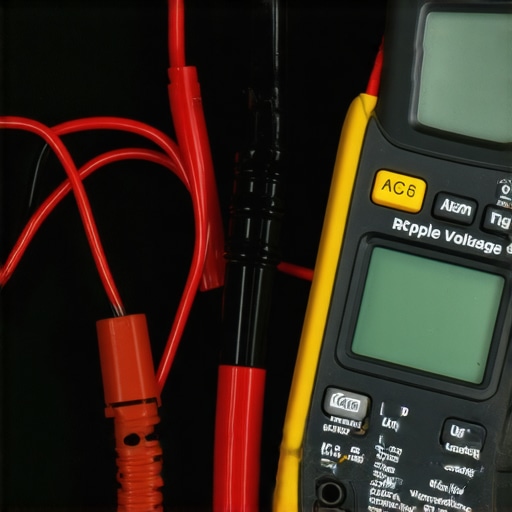
How much electrical noise can your car’s computer actually tolerate?
Modern Engine Control Units (ECUs) are masterpieces of engineering, but they rely on a ‘clean’ 12-volt signal to interpret data from sensors like the Mass Air Flow (MAF) or Oxygen (O2) sensors. When electrical noise from a failing alternator or a bad ignition coil enters the wiring harness, it creates digital ‘jitter.’ According to technical specifications from Robert Bosch GmbH, high-speed CAN-bus networks are specifically shielded to prevent interference, yet a significant voltage ripple can still induce phantom diagnostic trouble codes (DTCs) that point to healthy sensors. This is why a technician might see a ‘Lean’ code when the issue is actually electrical interference at the injector harness. To combat this, always verify the integrity of your main power feed before replacing expensive components identified by a scanner.
The Hidden Danger of Corroded Chassis Grounds
Electricity must always find its way back to the source, and in a vehicle, the entire metal frame acts as the return path. When a ground strap becomes frayed or corroded, the resistance increases, forcing the current to find ‘alternative’ paths through throttle cables, transmission linkages, or even small sensor wires. This often manifests as intermittent stalling or hard starting. You may have the hidden ground wire that causes intermittent starting issues without even realizing it. A quick way to test for a bad ground is the ‘voltage drop’ test: place one probe on the negative battery terminal and the other on the engine block while cranking. A reading higher than 0.2V suggests your ground path is compromised. This simple check is a staple of high-level vehicle diagnostics that prevents the needless replacement of starter motors.
Mastering the Art of Parasitic Draw Isolation
If your battery checks out and the alternator is clean, but the car is dead after sitting for 48 hours, you are dealing with a parasitic draw. This is often caused by a relay that ‘sticks’ in the closed position or a module that refuses to enter sleep mode. Rather than pulling fuses—which can wake up other modules and give false readings—experts use the ‘millivolt drop’ method across the top of the fuses. This technique allows you to see exactly which circuit is pulling current without breaking the circuit. If you are tired of the morning jump-start routine, we recommend checking out the $5 tool for finding electrical shorts in minutes to pinpoint the leak. Identifying these drains early can save your alternator from premature wear, as it won’t have to work at 100% capacity just to refill a flattened battery every time you drive. Before you spend hundreds at a car service, share this guide with a friend who is struggling with ‘ghost’ issues or leave a comment below if you’ve found a loose ground that solved a major headache.
Why Your Dashboard Lights Flicker When You Hit a Bump
Flickering lights are rarely about the bulbs themselves; they are almost always a sign of a loose connection or a vibrating short circuit. This is especially true in older vehicles where plastic connectors become brittle. Vibration-induced failures are some of the hardest to track down because they disappear as soon as the car is stationary on a lift. If you’ve experienced this, you know why your dashboard lights flicker when you hit a bump is usually tied to a loose bulkhead connector or a harness that has rubbed through its insulation against the firewall. Systematic inspection of the wire looms in the engine bay, particularly near moving parts or heat sources, is the only way to ensure long-term reliability for your daily driver.
The Mathematical Proof Your Power Cables Are Failing
While most DIY enthusiasts focus on the battery terminals, the internal health of the thick-gauge cables leading to the starter motor and fuse box often remains an unexamined variable. A cable can look perfectly intact from the outside while the copper strands within have succumbed to ‘wicking’ corrosion—a process where moisture and salt are drawn up under the insulation via capillary action. This internal decay significantly increases the circuit’s total impedance. To diagnose this without tearing the harness apart, you must perform a positive-side voltage drop test. By placing your digital multimeter probes at the battery positive post and the starter solenoid terminal during an engine crank, you can see exactly how much energy is being lost to heat. An ideal circuit loses less than 0.5V; anything higher indicates that your auto repair strategy should prioritize cable replacement over a new battery. If you are struggling with a slow crank despite a fresh charge, the $5 tool for finding electrical shorts in minutes can help identify if that resistance is localized or systemic.
Is Your Smart Charging System Actually Killing Your Battery?
In the quest for fuel efficiency, modern manufacturers have moved away from the traditional constant-voltage alternator. Today’s vehicles utilize ‘Smart Charging’ systems that vary alternator output based on engine load, temperature, and current battery state-of-health data provided by an Intelligent Battery Sensor (IBS). This means seeing 12.2V while the engine is running might actually be normal behavior—if the ECU determines the battery is at 80% capacity and wants to reduce engine drag. However, these systems require a ‘battery registration’ or ‘relearn’ procedure whenever a new unit is installed. If you skip this step during a car service, the ECU may continue to apply a high-voltage charging profile meant for an old, high-resistance battery to your new one, effectively ‘cooking’ it within months. Understanding the communication between the alternator and the engine management computer is a cornerstone of modern vehicle diagnostics that separates master technicians from parts-changers.

Thermal Stress and the Chemical Half-Life Paradox
Technical data from the Battery Council International (BCI) highlights that for every 15°F (8°C) rise in average operating temperature, the chemical life of a lead-acid battery is effectively cut in half. While winter ‘kills’ batteries by exposing existing weaknesses, it is the summer heat that does the actual structural damage. Heat accelerates internal grid corrosion and the evaporation of the electrolyte’s water content. This is why a vehicle’s transmission and cooling systems are so vital to electrical longevity—an overheating engine bay creates a localized kiln for the battery. If you’ve noticed your car becoming sluggish during heatwaves, you should investigate why your battery dies every morning even if the temperatures seem moderate now; the damage was likely done weeks ago during a peak thermal event.
The Critical Role of Shielded Wiring in Data Integrity
As we move deeper into the complexities of the CAN-bus (Controller Area Network), the physical integrity of the wiring becomes even more paramount. Unlike a simple 12V light bulb circuit, data lines operate on high-frequency voltage shifts. If the twisted-pair wiring is unraveled during a sloppy auto repair or if the shielding is compromised, electromagnetic interference (EMI) from the ignition coils can inject ‘noise’ into the data stream. This results in the transmission shifting erratically or the dashboard lighting up like a Christmas tree with U-series (network) codes. Diagnosing these ‘ghosts’ requires an oscilloscope rather than a simple multimeter, allowing you to visualize the square waves of the data packets. When the physical layer of the network is compromised, no amount of software updates or sensor replacements will stabilize the vehicle’s logic. The specific twist-rate of these wires—often exactly nine twists per foot—is calculated to cancel out magnetic fields, and even a minor repair that changes this geometry can lead to…
Stop Smearing Insulators Where Electrons Need to Flow
A persistent myth in the auto repair world involves the liberal application of dielectric grease directly onto battery posts. While intended to prevent corrosion, dielectric grease is, by definition, an insulator. When you coat the mating surfaces before assembly, you risk creating microscopic gaps in the electrical path, increasing the very resistance you seek to eliminate. The correct expert protocol involves securing the metal-to-metal connection first, then applying a sealant or specialized terminal spray over the completed assembly to lock out oxygen and moisture. This nuance ensures that the high-amperage draw required for modern vehicle diagnostics and starting cycles remains unimpeded by a layer of non-conductive silicone.
AGM Batteries Demand Specialized Charging Algorithms
If your vehicle is equipped with an Absorbent Glass Mat (AGM) battery—standard in many luxury and start-stop equipped cars—using a traditional ‘dumb’ charger can be a fatal mistake. AGM units are more sensitive to overcharging and heat than flooded lead-acid counterparts. Because the electrolyte is trapped in fiberglass mats, they cannot be ‘topped off’ with distilled water if they gassing occurs. According to technical deep-dives from Battery University by Cadex Electronics, charging an AGM at voltages exceeding 14.4V at room temperature can cause the pressure relief valves to open, leading to irreversible dry-out. Always ensure your car service equipment is set to the specific AGM mode to preserve the recombinant gas technology that gives these batteries their long cycle life.

Don’t Let Surface Charge Fool Your Multimeter
One of the most common traps in vehicle diagnostics is the ‘surface charge’ phenomenon. After a battery has been recently charged or the vehicle has been driven, the plates hold a temporary, elevated voltage that does not reflect the actual chemical state of charge. You might see a perfect 12.8V on your meter, yet the battery fails to turn the engine over ten minutes later. To obtain an accurate diagnostic reading, you must ‘strip’ the surface charge by turning on the high-beam headlights for 15 seconds without the engine running, then waiting a minute for the chemistry to stabilize. Only then will the resting voltage provide a true window into the battery’s health, preventing you from misdiagnosing a failing cell as a healthy one.
Does your start-stop system actually save money or just eat batteries?
The rise of micro-hybridization through Start-Stop technology has fundamentally changed the life cycle of the modern car battery. In a traditional vehicle, the battery performs one massive discharge to start the engine and then spends the rest of the trip being refilled. In a Start-Stop vehicle, the battery may endure twenty deep-discharge cycles in a single cross-town commute. This necessitates the use of Enhanced Flooded Batteries (EFB) or AGM units. While these systems save fuel, the ‘total cost of ownership’ often shifts toward more frequent and expensive car service intervals for battery replacement. If you notice your engine has stopped turning off at red lights, it is often the ECU’s way of telling you the battery’s internal resistance has risen too high to guarantee a restart, signaling that the hardware is nearing the end of its functional life.
The Invisible Threat of Electrolytic Stratification
In vehicles that are driven infrequently or for very short distances, a condition known as acid stratification occurs. Since sulfuric acid is heavier than water, it settles at the bottom of the battery casing over time, leaving the top of the plates under-activated and the bottom of the plates sitting in a highly concentrated, corrosive environment. This stratification leads to a ‘false high’ voltage reading but a massive loss in actual cranking power. Professional-grade auto repair shops use electronic testers that measure internal impedance to detect this, as a simple voltmeter cannot distinguish between a stratified battery and a healthy one. Maintaining a consistent driving schedule or using a smart maintainer is the only way to prevent this chemical separation from shortening your battery’s lifespan. Have you encountered a ‘phantom’ electrical issue that disappeared after a long highway drive? Share your experiences with electrical gremlins in the comments below, or reach out to see how our diagnostic protocols can save your transmission and engine modules from unnecessary power fluctuations.
Expert Insights & Advanced Considerations
The Invisible Threshold of Logic Grounding
In the world of vehicle diagnostics, we often talk about grounds, but rarely about the distinction between power grounds and logic grounds. A power ground handles the high-amperage return for components like your starter or headlights. A logic ground, however, provides the reference zero-point for sensitive sensors. When high-current noise bleeds into a logic ground due to a frayed strap, your sensors will report ‘floating’ data. If you want to see exactly where your electrical system is losing its reference, consider using the $20 scan tool that actually finds hidden transmission codes to monitor real-time PIDs for voltage fluctuations at the ECU level.
Why 14.4 Volts Is a Moving Target
Relying on a static 14.4V charging target is a rookie mistake in modern auto repair. As ambient temperatures drop, the chemical resistance of a battery increases, requiring a higher charging voltage (sometimes up to 15.2V) to push current into the plates. Conversely, in extreme heat, high voltage will boil the electrolyte. This is why checking your alternator’s performance must be coupled with an ambient temperature sensor reading. If your car is acting erratic in the heat, you might be seeing the surprising reason your transmission overheats while driving uphill—often a symptom of electrical heat soak affecting the solenoid control circuits.
Digital Oscilloscopes Are the Only Truth Tellers
A multimeter is an averaging tool; it is too slow to see the millisecond-long voltage drops that crash a CAN-bus network. True mastery of car service requires visualizing the waveform. If you’ve been chasing a ‘ghost’ code, you may need a deeper look. Tools like the $30 tool that lets you see inside your engine combined with a basic scope can reveal the micro-shorts that bypass traditional fuses. Stop replacing sensors and start measuring the electricity that powers them.
Curated Expert Resources
Battery University by Cadex
This is the gold standard for anyone who wants to move beyond the basics of lead-acid chemistry. It provides deep technical dives into lithium-ion, AGM, and EFB technologies, explaining the physics of ion transport and plate degradation that even most auto repair manuals gloss over.
SAE International Technical Papers
For those interested in the architecture of modern power grids, the SAE J-series standards are essential. These documents outline the protocols for smart charging and communication between the alternator and the engine management system, providing the ‘why’ behind every vehicle diagnostics procedure.
ASE Training Manuals
Professional certification materials from the National Institute for Automotive Service Excellence (ASE) focus on systematic elimination of variables. They are the best resource for learning how to perform voltage drop tests correctly without damaging sensitive modules during a car service.
#IMAGE_PLACEHOLDER_E#
Final Expert Perspective
Mastering vehicle diagnostics is less about owning the most expensive tools and more about understanding the fundamental laws of electricity. Whether you are chasing a parasitic drain or diagnosing a sulfated battery, the science remains the same: identify the resistance, verify the ground, and confirm the signal integrity. If you are tired of guessing and want a definitive answer to your car’s electrical mysteries, reach out to us through our contact page or explore our guide on unlocking your car’s potential with expert tips for 2025. True mechanical prowess begins where the guesswork ends.