When a vehicle exits a service bay with brand-new friction material and resurfaced rotors, the expectation is a centered, linear stop. However, a pull to the left post-service often indicates a deeper discrepancy in hydraulic balance or mechanical drag that simple parts swapping cannot resolve. This isn’t just a nuisance; it’s a diagnostic breadcrumb leading toward complex issues in brake torque distribution and chassis geometry. While many owners assume a professional car service guarantees perfection, the reality is that high-performance braking relies on a delicate equilibrium of pressure and friction across the entire axle.
Residual Drag and the Myth of the Plug-and-Play Caliper
A frequent culprit in the ‘post-brake job pull’ is the failure of a caliper to retract fully. During a standard auto repair, technicians often compress the caliper piston to make room for thicker pads. This movement can dislodge internal sediment or damage a hardened square-cut seal, preventing the piston from relaxing after the pedal is released. If the left front caliper maintains even a slight residual pressure, that wheel will effectively brake sooner and harder than the right. Furthermore, improper lubrication of the sliding pins can lead to uneven clamping force. It is essential to ensure the correct way to bed new brake pads is followed to prevent localized overheating and uneven material transfer, which further complicates lateral stability.
Is Your New Brake Job Fighting a Ghost in the Hydraulic Lines?
Sometimes the issue isn’t the hardware but the medium. Air trapped in the right-side brake line—even a tiny bubble—will compress, causing a delay in hydraulic force reaching that caliper. The result? The left side engages first, pulling the car in that direction. In more severe cases, an internal collapse of a flexible brake hose can act as a one-way check valve, holding pressure on one side of the car long after the driver has lifted their foot. Experts often recommend learning how to replace your own brake lines if you suspect internal degradation is causing intermittent pressure spikes. According to technical standards published by SAE International, even a minor 5% variance in hydraulic pressure between front calipers can result in significant lateral steering drift during high-load deceleration.
When Fresh Friction Exposes Hidden Suspension Flaws
Interestingly, the pull might not be the brakes’ fault at all. New pads provide significantly more ‘bite’ or brake torque. This increased force can reveal worn-out control arm bushings or ball joints on the left side. Under heavy braking, the force causes the suspension geometry to shift, essentially steering the wheel to the left because the bushings no longer maintain alignment under load. This is a common phenomenon where a vehicle diagnostics session reveals that the brakes are fine, but the chassis has failed. If you have already confirmed the alignment is within spec, you may still encounter issues similar to why your car pulls to the right even after an alignment, which often points back to dynamic toe changes under load. While some drivers mistake these symptoms for transmission hesitation or drivetrain issues, a sharp pull under braking is almost exclusively a hydraulic or suspension-related failure. For those looking to move beyond simple parts replacement, exploring the hidden world of vehicle diagnostics is the next logical step in mastering automotive maintenance.
Lateral Runout and the Precision of a Perfect Stop
One of the most insidious causes of a leftward pull after a brake job is excessive lateral runout. When a rotor is bolted to a hub that has even microscopic amounts of rust or debris, the rotor does not sit perfectly perpendicular to the spindle. As the wheel rotates, this slight ‘wobble’ pushes the brake pads back into the caliper further than intended on one side. Consequently, when you next apply the brakes, the side with less runout engages instantly, while the side with high runout has a delayed engagement. This discrepancy often explains why your brake pads are wearing unevenly on one side and creates a momentary but noticeable tug on the steering wheel during the initial bite. Mastering the one maintenance move that doubles the life of your rotors—which involves meticulously cleaning the hub-to-rotor mating surface—is often the difference between a mediocre repair and a factory-quality finish.
Could Your Master Cylinder Be Favoring One Side?
While many focus on the wheel-end components, the source of the pull may reside within the master cylinder or the ABS modulator. In modern vehicles, the hydraulic system is often split into diagonal circuits for safety. If the primary or secondary seal within the master cylinder begins to bypass internally, pressure may rise more slowly in one circuit than the other. This isn’t always enough to trigger a warning light, but it is enough to cause a lateral drift during heavy braking. Experts at the National Institute for Automotive Service Excellence (ASE) recommend that technicians check for hydraulic lead by measuring the temperature difference between rotors after a controlled stop; a variance of more than 20% indicates that one caliper is working harder than its partner. For enthusiasts seeking the secret to getting a perfect brake pedal every time, checking these thermal signatures is a standard diagnostic step that bypasses the guesswork of manual bleeding.
Why Clean Hubs Matter More Than You Think
The interface between the wheel bearing hub and the brake rotor is a zero-tolerance zone. A mere 0.005 inches of lateral runout at the hub can translate to significant pedal pulsation and lateral pull at the wheel. 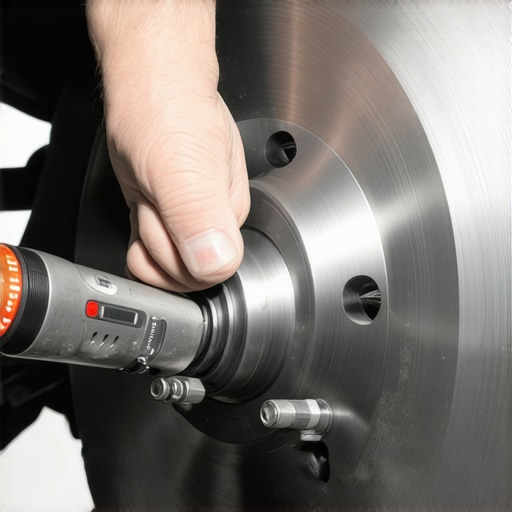 Technicians frequently skip the step of using a wire wheel or specialized hub cleaning tool, assuming the clamping force of the lug nuts will flatten any irregularities. It won’t. In fact, uneven torque on the lug nuts themselves can distort the rotor hat, leading to a pull that feels identical to a suspension failure. This nuance is also why drivers often find why your steering wheel is off-center after a repair; the mechanical centerline has been compromised by improper installation procedures rather than actual alignment shifts. If your car still feels like it’s fighting you after a professional service, drop a comment below with your vehicle’s mileage and the specific parts replaced; our community of experts often spots the missing link in complex diagnostic puzzles. By shifting focus from the parts to the precision of the installation, you ensure the vehicle’s safety systems operate as a cohesive unit rather than a collection of conflicting forces.
When Electronic Logic Fights Mechanical Precision
While the physical clamping of pads to rotors is a mechanical event, the command for that pressure increasingly originates from a complex network of sensors and microprocessors. Modern Electronic Brakeforce Distribution (EBD) systems don’t just split pressure front-to-rear; they modulate individual wheel corners to optimize stability based on steering input and yaw rates. If a wheel speed sensor is sending a slightly noisy or erratic signal—even without throwing a dashboard code—the ABS module might prematurely reduce pressure to the right front wheel to prevent what it perceives as an impending lock-up. This digital intervention results in the left side doing the heavy lifting, pulling the steering wheel toward the stronger anchor. For drivers who have replaced every physical component, this software-level discrepancy is often the final frontier of troubleshooting. Technical data from NHTSA safety standards regarding Federal Motor Vehicle Safety Standard (FMVSS) 135 emphasizes that modern braking performance is heavily dependent on these electronic control systems maintaining perfect synchronization with mechanical hardware.

Does an Off-Center Steering Angle Sensor Cause Pulling During Braking?
Many modern vehicles equipped with Electronic Power Steering (EPS) utilize a feature known as ‘Active Lead-Pull Compensation.’ This system is designed to counteract road crown or crosswinds by applying a subtle steering torque in the opposite direction. However, if your technician performed an alignment or suspension work alongside the brake job and failed to reset the Steering Angle Sensor (SAS) to zero, the EPS motor may provide assistance at the wrong moment. When you apply the brakes and the front end ‘dives,’ the change in caster and toe can trigger an erroneous response from the SAS. The car effectively tries to steer itself left because it believes the driver is attempting to compensate for a drift that isn’t actually there. This is why a vehicle diagnostics scan of the steering control module is non-negotiable after any significant front-end work.
The Hidden Trap of Radial Tire Pull After a Fresh Service
It is remarkably common for a ‘brake pull’ to be a simple case of bad timing regarding tire wear. During a comprehensive car service, tires are often rotated. If one of the front tires has developed a ‘radial pull’—a condition where the internal steel belts have shifted or worn unevenly—moving that tire to a different position can suddenly cause the car to veer during deceleration. The increased load transfer to the front axle during braking magnifies this defect. To rule this out, a quick diagnostic trick is to swap the left and right front tires. If the pull switches to the right, you’ve confirmed a tire carcass failure rather than a transmission or brake fault. This scenario highlights why tires should be inspected for conicity as part of a high-level auto repair strategy. If you are experiencing a steering vibration alongside the pull, checking how to fix steering wheel shaking when braking can help narrow down if the issue is rotational or purely hydraulic. Have you ever noticed your car behaving differently on concrete versus asphalt? Our experts are curious to hear your observations in the comments below, as road surface texture often reveals the subtle difference between a mechanical bind and a tire-related drift.
Dynamic Alignment Shifts and Bushing Deflection
Static alignment specs on a rack rarely tell the whole story. Under the heavy torque of new, aggressive brake pads, the suspension components are subjected to forces that can exceed several thousand pounds. If the compliance bushings in the lower control arms have softened with age, the left wheel may physically move backward (loss of caster) or turn outward (toe-out) more than the right wheel when the brakes bite. This dynamic shift in geometry creates a ‘steering’ effect that only exists when the brake pedal is depressed. In these instances, the brakes are performing perfectly, but the chassis is failing to hold the wheel in its proper orientation. This phenomenon is a prime example of how a high-quality brake service can unintentionally expose latent weaknesses in the vehicle’s structural foundation.
The transition from mechanical force to thermal energy is never perfectly symmetrical, yet modern automotive engineering strives for a negligible delta. When a vehicle exhibits a pull to the left, we must look beyond static components and investigate the kinetic environment of the wheel end. A subtle but frequent oversight during a standard car service is the integrity of the brake cooling ducts or air deflectors. If the right-side cooling path is obstructed by a misplaced splash shield or road debris, that rotor will operate at a higher baseline temperature. According to technical friction studies by Brembo, a significant temperature differential can cause ‘friction fade’ on the hotter side, resulting in the cooler left side maintaining a higher coefficient of friction and pulling the vehicle in that direction. This thermal imbalance effectively creates a dynamic torque steer that only manifests once the brakes reach operating temperature.
Why Heat Management Dictates Your Steering Path
Thermal capacity is the silent partner in every stop. When technicians perform an auto repair involving high-performance or heavy-duty ceramic pads, the bedding process is critical because these materials require a specific heat range to transfer a layer of friction material to the rotor face. If the left side beds more efficiently than the right due to variations in surface finish or cooling, the car will perpetually favor the left.  This discrepancy is often exacerbated by the use of mismatched lubricants on the slide pins; using a petroleum-based grease instead of a high-temp silicone or synthetic lubricant can cause the right side to react slower as it heats up and expands, leaving the left side to handle the initial bite of the deceleration. Monitoring these thermal signatures with a non-contact pyrometer is often the only way to catch this ‘invisible’ pull.
Can a Failing Proportioning Valve Mimic a Seized Caliper?
In older hydraulic architectures and some modern heavy-duty applications, the proportioning valve—or the internal valving within the ABS HCU (Hydraulic Control Unit)—serves as the gatekeeper for pressure. If an internal seal has slightly rolled or a micro-orifice is partially clogged with hygroscopic debris from old fluid, the pressure rise rate (the speed at which pressure builds) may be slower on the right front circuit than the left. While the peak pressure might eventually equalize, the ‘onset’ of braking is lopsided. This creates a momentary but violent jerk to the left the moment you touch the pedal. This is why a deep-dive vehicle diagnostics session must include a pressure transducer test at the calipers to ensure that 1,000 PSI at the master cylinder translates to 1,000 PSI at both front wheels simultaneously.
Stop Chasing Calipers and Check Your Hub Play
Even if every hydraulic component is factory-fresh, a minute amount of axial play in the left front wheel bearing can wreak havoc on your alignment under load. While the bearing might not yet be ‘growling’ or showing play on a lift, the massive clamping force of a new brake job can cause the rotor to tilt slightly within the caliper bracket. This tilt changes the contact patch of the pads, often increasing the ‘leading edge’ bite on the left side. It is a nuanced failure point where the transmission of force through the hub is compromised by a bearing that is within static spec but fails under dynamic load. Professionals often overlook this, assuming that if there is no noise, the bearing is fine. However, the reality of high-torque braking is that even 0.002 inches of deflection can be felt through the steering rack. Have you encountered a pull that only appears during high-speed stops? Share your findings in the comments below, as your specific data on rotor runout could help another driver solve a persistent safety issue. Refining your approach from ‘part swapping’ to ‘load-based analysis’ is the hallmark of master-level maintenance.
Expert Insights & Advanced Considerations
Replace Single-Use Hardware to Maintain Clamping Force
Many modern calipers utilize torque-to-yield bolts or specialized clips that lose their tension after one use. Reusing these components during a car service can lead to microscopic shifts in the caliper position under heavy load, causing a momentary pull to the left as the hardware settles. For those attempting a DIY fix, knowing how to free a seized brake caliper without replacing the whole unit is a valuable skill, but always ensure the mounting hardware is renewed to factory specifications.
Stop Water Vapor from Compromising Your Hydraulic Circuit
Brake fluid is hygroscopic, meaning it absorbs moisture over time. Even if you only replaced pads, if the system wasn’t properly bled, the localized boiling point of old fluid near the calipers can vary. This creates uneven pressure gradients during aggressive stops. Mastering how to flush your brake lines without a second person helping ensures you maintain a pure hydraulic medium, which is critical for side-to-side braking parity.
Use a Dial Indicator to Rule Out Mechanical Runout
Technicians who rely solely on visual inspections often miss the 0.003-inch runout that causes a steering tug. Professional auto repair should always include a dial indicator test on the rotor face. If you find high spots, refer to the one maintenance move that doubles the life of your rotors to ensure the hub surface is perfectly flat before final assembly.
Why High-Temperature Lubricants Outperform Traditional Greases
The use of generic multi-purpose grease on slide pins is a common failure point. These greases can swell rubber bushings or thin out under heat, causing the right-side caliper to lag behind the left. Using a dedicated ceramic-based lubricant is a small detail that prevents the lopsided braking feel that plagues many post-service vehicles.
Curated Expert Resources
ASE Advanced Engine Performance Specialist Data
The National Institute for Automotive Service Excellence provides rigorous diagnostic frameworks that go beyond basic part swapping, focusing on the systemic interaction between the transmission, chassis, and braking system.
SAE International Technical Papers
This is the gold standard for engineering data regarding friction material coefficients and hydraulic pressure rise rates, offering the deep-level physics behind why a car might drift under deceleration.
NHTSA Safety Recall Database
An essential tool for checking if your specific vehicle model has known issues with ABS modulator valves or proportioning logic that could cause uneven braking forces.
Final Expert Perspective
A vehicle that pulls to the left after a brake job is communicating a specific technical imbalance that requires more than a cursory inspection. Whether it is a subtle hydraulic delay, a shifting suspension bushing, or a microscopic alignment error, the solution lies in the precision of the installation rather than the quality of the pads alone. True vehicle diagnostics involve looking at the car as an integrated system where the transmission of force must be perfectly symmetrical. If your recent auto repair hasn’t resolved the issue, it may be time to dig into the hidden world of vehicle diagnostics to identify the root cause. We invite you to share your specific diagnostic data or symptoms in our community forum; your experience could be the key to solving a complex mechanical puzzle for another driver.