The Chemistry and Physics of Accelerative Voltage Drops
When you press down on the accelerator pedal, your engine demands an immediate, coordinated surge of mechanical and electrical resources. In a perfectly balanced vehicle, this action should not affect your interior electronics. However, if your dashboard lights dim during acceleration, it indicates an electrical bottleneck where the vehicle’s charging system cannot keep pace with the temporary spike in demand. This phenomenon often points to a breakdown in the delicate relationship between the battery, the alternator, and the vehicle’s complex grounding network. To diagnose this issue accurately, a technician must look beyond basic battery health and examine the dynamic impedance of the charging circuit under load.
Why Does Your Electrical System Sag Under Engine Load?
At idle, an engine requires minimal electrical current to keep its systems running. However, when you accelerate, several high-draw components engage simultaneously. The ignition system must produce hotter, more frequent sparks; the electric fuel pump spins faster to supply extra fuel; and the transmission control module actively calculates shift points. If your alternator is suffering from worn brushes, a failing voltage regulator, or a slipping belt, its power output will momentarily sag under this sudden torque. To understand how these components interact, you can learn more about the simple way to tell if your alternator is toast without a mechanic. When the alternator cannot handle the load, the system draws supplementary current directly from the battery, causing a temporary drop in system voltage that dims your dashboard illumination.
Could a Faulty Ground Wire Cause Dimming Lights?
Yes, a compromised ground return path is one of the most common, yet frequently overlooked, causes of transient electrical issues. Because a car’s metal chassis acts as the negative return path for the entire electrical system, any rust, corrosion, or looseness at a major grounding point increases circuit resistance. Under acceleration, the engine physically twists on its rubber mounts, which can stress or temporarily break contact at a worn engine-to-chassis ground strap. When resistance spikes in this manner, the voltage drop across the circuit increases, starving your dashboard components of the stable 12 to 14 volts they require. This structural vulnerability is why seasoned technicians often recommend implementing the ground wire hack for flickering headlights to bypass degraded factory wiring harness paths.
Restoring Your Vehicle’s Electrical Equilibrium
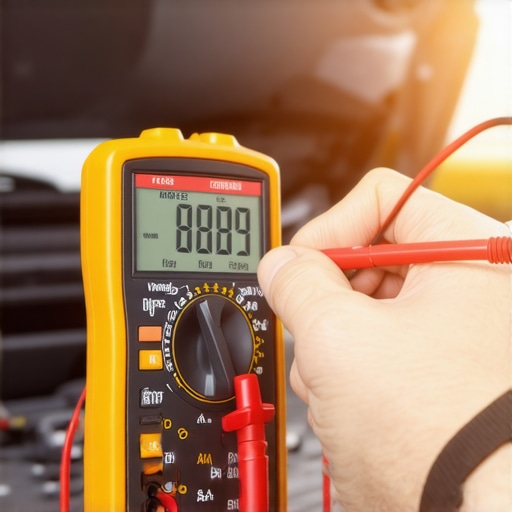
Resolving this diagnostic puzzle requires a systematic approach. Technicians start by performing a dynamic charging system test using a digital multimeter to measure voltage fluctuations under load. According to the automotive engineering standards published by the Society of Automotive Engineers (SAE), a healthy charging system should consistently maintain between 13.5 and 14.7 volts, even when high-draw accessories are active. If your voltage drops below this threshold during acceleration, it is imperative to seek professional vehicle diagnostics to isolate whether the culprit is a failing alternator regulator, a corrupted ground connection, or a failing battery. Address these symptoms early before a minor electrical sag turns into a complete roadside breakdown. If you are noticing other electrical anomalies, consider checking out our guide on how to handle starter motor issues to ensure your car remains reliable in any driving condition.
How Transient Electrical Draws Fool the Powertrain Control Module
Modern vehicles rely heavily on clean, uninterrupted voltage to maintain communication between various electronic control units. When your dashboard lights dim under acceleration, the drop in voltage does not just affect your visibility; it can actively disrupt the signals sent to the Powertrain Control Module (PCM). A sudden voltage sag can cause sensor reference voltages to fluctuate, leading to erroneous readings from critical components like the Throttle Position Sensor (TPS) or Mass Air Flow (MAF) sensor. These erratic readings can trick the engine management system into commanding incorrect fuel trims, which often results in minor driveability issues. If you notice your vehicle struggle beyond just the dimming lights, you might be experiencing a scenario where your engine hesitates at stoplights or during sudden throttle tip-ins.
What If the Real Culprit Is Your Serpentine Belt Slip?
While many drivers immediately blame a failing alternator internal regulator or a dying battery, mechanical slip under high engine load is a highly common physical cause. During rapid acceleration, the crankshaft pulley accelerates quickly, but the inertia of the alternator rotor resists this sudden speed change. If your serpentine belt is stretched or the automatic tensioner has lost its spring tension, the belt will momentarily slip over the alternator pulley. This slip is often completely silent, yet it drastically reduces the alternator’s rotational speed and output precisely when the car’s electrical demand peaks. To determine if your belt is up to the task, you can use the simple way to inspect your serpentine belt for micro-cracks before investing in an expensive alternator replacement.

Isolating Voltage Drop with a Multimeter
To pinpoint the exact location of the resistance causing your lights to dim, you must perform a dynamic voltage drop test rather than simple resistance checks. Standard resistance testing with an ohmmeter only sends a tiny milliamp current through the wire, which will not expose a degraded circuit that fails under a heavy load. By setting your digital multimeter to the millivolt scale, you can measure the voltage difference between the positive battery terminal and the alternator output post while the engine is running and under load. According to the National Institute for Automotive Service Excellence (ASE), any voltage drop exceeding 0.2 volts on a single automotive circuit wire indicates excessive resistance that requires cleaning or replacement. If your test results indicate that the charging path is stable, the issue might lie in local circuit pathways, such as a localized short-circuit, a blown fuse, or even a parasitic draw that has compromised your battery over time. For those looking to dive deeper into electrical testing, mastering how to find a parasitic drain with a cheap multimeter can save you hundreds of dollars in diagnostic fees. Have you encountered mysterious electrical gremlins like this in your own vehicle? Let us know in the comments below, or share this guide with a friend who is currently chasing down a dashboard flicker.
Can a Weak Battery Cause Dashboard Dimming Even If the Engine Starts Easily?
Many drivers assume that if an engine cranks over and starts without hesitation, the battery must be in perfect health. This is a common misconception that overlooks the complex physics of battery chemistry. A car battery might possess enough cold cranking amps (CCA) to power the starter motor for a few seconds, yet suffer from high internal resistance that prevents it from acting as an effective buffer, or capacitor, for the charging system. Under rapid acceleration, when the alternator momentarily struggles to match the sudden current demand of the ignition coils and fuel injectors, a healthy battery step-ins to absorb the transient deficit. If the battery’s internal resistance is too high due to plate sulfation or active material shedding, it cannot discharge rapidly enough to stabilize the system. According to battery research data compiled by the Battery Council International (BCI), electrochemical degradation can restrict transient current delivery by up to forty percent before the battery fails a standard static voltage test. This lag in supplementary power delivery causes the overall system voltage to drop for a fraction of a second, which is visible to the driver as a temporary dimming of the dashboard instrumentation and interior lighting.
How Does Your Voltage Regulator Manage Sudden Thermal Shifts?
Inside every modern alternator is an electronic voltage regulator that actively monitors system demands and adjusts the field current to maintain a stable electrical output. However, voltage regulators are highly sensitive to thermal stress. As the engine bay heats up during spirited driving or heavy acceleration, the regulator’s semiconductor components experience increased electrical resistance. If the regulator is aging or has suffered minor micro-crack damage over years of heat cycles, its response time to load changes slows down dramatically. When you step on the gas pedal, the sudden change in alternator shaft speed combined with high thermal resistance prevents the regulator from adjusting the rotor magnetic field quickly enough. This delay creates a brief power vacuum where the system voltage dips before recovering to its normal operating range.
Why High-End Audio Systems Aggravate Acceleration Dips
Aftermarket electronic installations represent one of the most frequent causes of unexplained dashboard dimming. High-power subwoofers and multi-channel amplifiers demand massive bursts of instantaneous current to reproduce low-frequency bass notes. If these audio components are wired directly into the factory electrical distribution block without a dedicated capacitor or secondary battery, they place an immense strain on the electrical system. When you accelerate, your vehicle’s factory computers, fuel delivery pumps, and ignition modules are already drawing peak current. If a heavy bass note hits at the exact same millisecond you press the accelerator pedal, the combined current draw will overwhelm even a brand-new factory alternator. This sudden, dual-source draw causes a major voltage drop across the main power distribution bus, starving your dashboard LEDs of the clean, regulated current they need to remain at full brightness.
Evaluating the Alternator Decoupler Pulley for Mechanical Lag
To maximize fuel efficiency and reduce belt wear, many modern vehicles utilize an Overrunning Alternator Decoupler (OAD) or an Alternator Freewheel Pulley (AFP) instead of a traditional solid metal pulley. These advanced pulleys contain an internal spring and clutch mechanism designed to absorb the torsional vibrations of the engine and allow the heavy alternator rotor to freewheel when engine speed suddenly drops. Over time, the internal spring can weaken or the clutch mechanism can begin to lock up. When this happens, the pulley can no longer smoothly transfer the rapid speed changes of the engine crankshaft to the alternator rotor. During hard acceleration, a failing decoupler pulley might slip or bind, preventing the alternator from spinning up to the required speed as fast as the engine is revving. This mechanical lag directly translates to a temporary drop in electrical output, resulting in the classic dashboard flicker that puzzles so many DIY mechanics.
Why Does Smart Charging Tech Delay Your Alternator Response?
Modern vehicles frequently employ computerized Smart Charging Systems (SCS) to prioritize fuel economy over constant voltage output. Unlike older, analog systems that maintained a flat 14-volt output, a smart charging system actively commands the alternator to enter a low-output state when the engine is under high mechanical load, such as rapid acceleration. This reducing of alternator drag frees up valuable horsepower for the wheels. In most cases, this smart transition is seamless because the battery is supposed to buffer the temporary deficit. However, if your vehicle has been fitted with an incorrect battery type—such as a standard flooded lead-acid battery instead of an Absorbed Glass Mat (AGM) battery required by the vehicle’s electronic control unit—the battery cannot discharge fast enough to handle this deliberate, temporary drop in alternator output. The result is an immediate, visible dimming of your cabin electronics as the system transitions between power sources.
How Do You Reset Your Vehicle Engine Computer After Replacing an AGM Battery?
When you install a new battery in a vehicle equipped with an intelligent battery sensor, you must perform a battery management system (BMS) reset using a professional diagnostic scan tool. Failing to register the new battery causes the engine control module to continue applying charging profiles optimized for an old, degraded battery. This miscalculation leads to severe voltage instability and persistent dashboard dimming during acceleration, as the computer fails to properly coordinate the alternator output with the battery’s actual current capacity. For precise procedures on resetting these complex monitoring modules, refer to the diagnostic guidelines maintained by the International Automotive Technicians Network (iATN).

Corroded Fusible Links Lurking Inside Your Main Wiring Harness
While technicians frequently inspect the battery terminals and primary engine ground straps, the fusible links buried deep within your main wiring harness are often completely ignored. A fusible link is a short piece of low-voltage wire wrapped in fire-resistant insulation, designed to melt and open the circuit during an extreme overcurrent event. Over years of exposure to engine bay heat, moisture, and road salt, these links can develop internal copper corrosion without showing any external physical damage. This corrosion increases the circuit’s overall resistance. Under low-load idling conditions, the degraded link can still pass enough current to power your dashboard. But the moment you accelerate and demand high current for your ignition coils and electric power steering, the bottlenecked fusible link drops voltage drastically, starving the interior cabin fuse box of stable current and causing your instrument cluster to dim. Chasing this hidden electrical resistance requires a systematic, section-by-section voltage drop test across the main power distribution harness to identify the precise point of energy loss.
Expert Insights & Advanced Considerations
The Illusion of the Static Battery Test
Many technicians fall into the trap of relying solely on a static open-circuit voltage test or a basic handheld load test. When resolving complex transient issues where dashboard lights dim during acceleration, you must analyze dynamic impedance under active load. A battery can show a healthy 12.6 volts at rest but fail completely to buffer the electrical system when the alternator temporarily cuts output during heavy throttle application. Understanding this distinction is critical to avoiding misdiagnoses and unnecessary component replacements.
Why Smart Charging Calibration Demands AGM Battery Precision
Modern smart charging systems are programmed with highly specific battery chemistry algorithms. If a vehicle engineered for an Absorbed Glass Mat (AGM) battery is retrofitted with a standard flooded cell unit, the Powertrain Control Module will miscalculate the state of charge and internal resistance. This mismatch causes severe voltage dips during sudden mechanical loads. For those pursuing advanced troubleshooting, mastering the secret to extending your car battery life by two years provides excellent foundational knowledge on battery chemistry and charging characteristics.
The Hidden Risk of Aftermarket Accessory Integration
Splicing high-draw electrical accessories into existing factory harness paths is a primary driver of voltage sags. When heavy-gauge power lines for aftermarket audio or lighting are tied directly to the main cabin fuse box rather than a dedicated, fused run to the battery, you create a localized bottleneck. Under heavy engine acceleration, the primary electrical distribution bus is starved, dropping voltage below the critical threshold required to keep instrument backlights stable.
Curated Expert Resources
The International Automotive Technicians Network (iATN)
An invaluable repository of real-world diagnostic data, offering deep peer-reviewed discussions and case studies on obscure electrical faults, transient voltage drops, and complex ground path failures across thousands of vehicle platforms.
Society of Automotive Engineers (SAE) Technical Papers
The premier source for understanding the physics of automotive electrical architecture. These publications provide the underlying engineering standards governing modern smart charging algorithms and electrical transient suppression.
The National Institute for Automotive Service Excellence (ASE) Study Guides
An essential resource for refining diagnostic methodology. Their advanced engine performance and electrical systems training materials outline the precise voltage drop testing protocols needed to isolate high-resistance circuits without guesswork.
Final Expert Perspective
Chasing down intermittent electrical anomalies requires moving beyond basic component swapping and adopting a systematic diagnostic methodology. When dashboard lights dim during acceleration, the symptom is rarely a simple component failure; rather, it is a sign of dynamic resistance, mechanical slippage, or algorithmic battery management lag. By utilizing a high-quality digital multimeter to conduct precise voltage drop tests, you can isolate the bottleneck before it develops into a more serious failure. To expand your mechanical skill set, consider learning the simple way to inspect your serpentine belt for micro-cracks, or explore our detailed breakdown on vehicle diagnostics. What are your go-to strategies for tracing phantom voltage sags? Share your diagnostic breakthroughs or ask a technical question in the comments below.