An oscillating side mirror is more than a minor annoyance; it is a significant degradation of situational awareness that can lead to catastrophic lane-change errors. From an engineering standpoint, what many drivers perceive as a simple loose component is often a symptom of structural fatigue in the mounting assembly or a failure of the thermal adhesive bond. While a generalist might suggest a full housing replacement, a systematic approach to vehicle diagnostics reveals that the solution is often a localized mechanical adjustment or a specific chemical bonding process.
Stop the Vibration Before It Blurs Your Vision
A vibrating mirror housing typically stems from three primary failure points: loosened mounting bolts, worn plastic retaining clips, or a deteriorating rubber base gasket that has lost its dampening properties. When performing a professional auto repair, the first step is to isolate the movement. If the entire housing moves, the fault lies in the attachment to the door frame. This requires removing the interior trim panel with non-marring tools to access the mirror’s mounting nuts. According to standards set by the National Highway Traffic Safety Administration (NHTSA), mirror stability is essential for meeting safety criteria regarding field of view.
Why does mirror glass detach even when the housing is secure?
This specific failure is frequently caused by environmental stressors—specifically UV degradation and extreme thermal expansion cycles—which cause the manufacturer’s adhesive to become brittle. In many late-model vehicles, the glass is held to the actuator plate by high-bond foam tape that eventually loses its chemical tack. To rectify this without the expense of a new motor assembly, one must meticulously clean the glass substrate with isopropyl alcohol and apply a specialized silicone-based automotive adhesive. This ensures the repair remains resilient against the high-frequency vibrations of highway speeds.
Mechanical Synergy and the Dangers of Neglect
Expert-level car service involves looking beyond the immediate symptom. Excessive cabin vibration that manifests through the side mirrors can occasionally indicate deeper mechanical imbalances, such as failing engine mounts or even early-stage transmission failures. If you observe that the mirror shake correlates directly with engine RPM or gear shifts, the mirror is merely the messenger for a drivetrain issue. Addressing these small mechanical inconsistencies early prevents them from escalating into costly overhaul projects. For those who prioritize vehicle longevity and safety, we invite you to contact our technical team for a comprehensive diagnostic review of your vehicle’s structural and mechanical health. [image placeholder]
High-Speed Buffeting: Why a Loose Seal Destroys Visibility
At speeds exceeding 60 mph, the side mirrors encounter significant wind resistance, creating a high-pressure zone on the glass face and a low-pressure wake behind it. If the mirror’s internal structure has even microscopic play, these pressure differentials create a flutter effect that compromises safety. This is not just a nuisance; it is an aerodynamic failure. A damaged or missing rubber gasket does not just fail to dampen vibrations—it allows wind to penetrate the mirror housing, creating internal turbulence that can eventually snap the plastic pivot points. To address this, technicians must inspect the weather stripping around the mirror base to ensure the seal remains airtight, preventing the lift and drag forces from oscillating the entire assembly.
Heated Elements and Sensors Add Complexity to Simple Fixes
Modern mirrors are no longer just glass and plastic; they are sophisticated nodes in the vehicle’s Controller Area Network. When a heated mirror fails or a blind-spot indicator begins to flicker, the instinct is to replace the glass immediately. However, an expert knows to check the electrical continuity first. Corroded pins in the door harness can mimic a dead motor or a failed heating element. You can often identify a bad ground wire without a multimeter by observing if the mirror’s electronic functions fail simultaneously with other door-mounted components, such as the power locks or window switches. Ensuring clean contacts is vital because increased electrical resistance can lead to heat buildup, further weakening the plastic adhesives holding the mirror glass in place.
Could that high-speed mirror shimmer be a warning from your wheel hubs?
It is a common diagnostic error to assume that because the mirror is shaking, the mirror is the problem. High-frequency vibrations travel through the chassis with surprising efficiency. If your mirror begins to blur only at specific velocities, it may be echoing a mechanical disharmony elsewhere. For instance, why your steering wheel vibrates at exactly 60 mph often shares the same root cause as mirror shimmy: unbalanced tires or a slightly bent rim. More critically, you should learn to recognize the specific noise your wheel bearing makes before it fails, as the secondary vibration from a dying hub often manifests first as a fine, high-frequency oscillation in the side mirrors long before the characteristic growl becomes audible.
Differentiate Between Aerodynamic Drag and Mechanical Harmonics
To truly master vehicle diagnostics, one must distinguish between wind-induced and chassis-induced movement. If the glass remains steady while the vehicle is idling but vibrates under load, the engine mounts are suspect. Conversely, if the vibration is purely speed-dependent, the focus shifts to the rotating mass—tires, brakes, and driveshafts. The Society of Automotive Engineers (SAE) notes in their research on Advanced Driver Assistance Systems (ADAS) integrity that modern safety sensors located within side mirrors require absolute stability to function within their engineered tolerances. A mirror that shakes more than a few millimeters from its center point during travel can trigger false positives in blind-spot systems or, worse, fail to detect a vehicle in the adjacent lane. #IMAGE_PLACE_HOLDER_B#
Precision Alignment vs. Quick Fixes
While some DIY enthusiasts might reach for a tube of generic adhesive, the professional technician understands the importance of thermal expansion coefficients. The materials used in mirror assemblies—polycarbonate, glass, and aluminum—all expand and contract at different rates. Using an inflexible glue will cause the glass to crack during the first frost of winter. Instead, use automotive-grade butyl or specialized flexible resins that maintain their grip despite temperature swings. If you are unsure whether your vehicle’s issues are purely cosmetic or deeply mechanical, explore our guide on how to find reliable car service near you in 2025 to ensure you are getting expert-level care for these critical safety components.
Precision Adhesives and the Battle Against Thermal Fatigue
While mechanical fixes address the physical movement, the chemistry of the repair determines its lifespan. Most DIY enthusiasts make the mistake of using cyanoacrylate-based “super glues,” which lack the necessary shear strength and flexibility required for automotive environments. As the vehicle transitions from a heated garage to sub-zero outdoor temperatures, the disparate expansion rates of the glass and the plastic backing plate create massive internal stress. If the adhesive cannot “give” slightly, it will either shear the bond or fracture the substrate. High-performance polyurethane sealants are the industry standard because they maintain a molecular “memory” that accommodates these environmental shifts without sacrificing structural integrity.
Does an unstable mirror housing trigger false-positive blind-spot warnings?
Absolutely. In vehicles equipped with integrated Blind Spot Detection (BSD) sensors, the mirror housing serves as a stabilized platform for short-range radar or camera modules. When the housing oscillates due to wind buffeting or loose mounting hardware, the sensor’s focal point shifts rapidly. This creates “signal noise” that the onboard computer may interpret as a moving object, leading to those frustrating phantom alerts. According to the Insurance Institute for Highway Safety (IIHS), the efficacy of crash avoidance systems is heavily reliant on the physical alignment of these sensors, as even a one-degree deviation can result in a detection error at distances exceeding twenty feet.
The Resonance Frequency Trap in Electric Vehicles
In internal combustion engines, the noise floor is relatively high, often masking the subtle vibrations of a loosening mirror. However, in the silent cabin of an Electric Vehicle (EV), these oscillations become both more audible and more physically apparent. Because EVs lack the rhythmic vibration of an engine, high-frequency harmonics from the tires or road surface transmit through the chassis with less interference. If you find that your side mirror begins to “sing”—a high-pitched whistling or humming sound—at highway speeds, it is often a sign that the internal plastic baffles have become misaligned. This is not just a sound issue; it is an indicator of aerodynamic drag that can marginally reduce your battery range over long distances.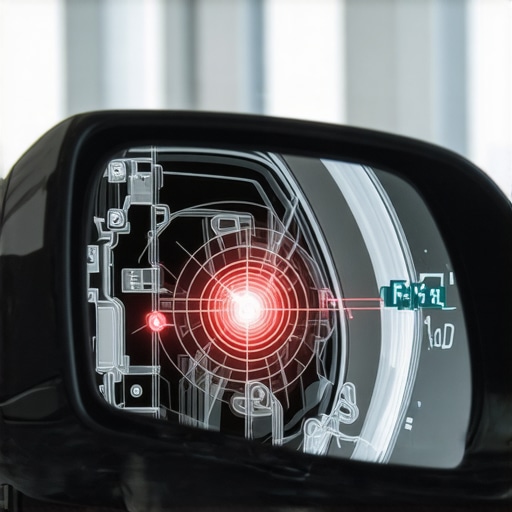
Manual Folding Mechanisms and the Risk of Detent Wear
Every time you manually fold your mirrors to squeeze into a tight parking space, you are stressing the internal detent springs and plastic stops. Over several years, the friction wears down the notches that lock the mirror into its “drive” position. This results in a mirror that seems secure but “creeps” backward under the pressure of high-speed airflow. If your mirror requires constant manual adjustment after every highway trip, the internal spring tension has likely dropped below the manufacturer’s specified threshold. To see if your vehicle is prone to this, you might check advanced vehicle diagnostics techniques that focus on structural wear. Before committing to a complete replacement, a specialized technician can often shim the internal spring to restore the factory-spec tension, saving hundreds in parts costs.
Why Mirror Glass Discoloration is a Symptom of Internal Heat
Beyond physical movement, pay close attention to the clarity of the glass. If you notice a brownish “tea-stain” around the edges, it usually indicates a breach in the seal of the electrochromic (auto-dimming) fluid. This chemical leakage is often accelerated by the very vibrations we’ve been discussing. The constant shaking creates micro-fissures in the glass laminate, allowing oxygen to react with the dimming gel. If this happens, the heater circuit may also begin to draw excessive current, potentially blowing a fuse or damaging the door control module. For a deeper look at electrical gremlins that start small but end big, our guide on how to identify a bad ground wire without a multimeter offers vital insights for DIYers and pros alike. The aerodynamic relationship between the mirror and the A-pillar is a delicate balance of fluid dynamics; when a mirror is even slightly out of alignment, it creates a vortex shedding effect that can vibrate the side window itself, leading to a mystery rattle that many drivers misdiagnose as……misdiagnosed as a failing window regulator or a loose door latch mechanism.
Identify Stress Whitening Before the Mounting Arm Snaps
When a mirror assembly is subjected to perpetual oscillation, the plastic polymers undergo a phenomenon known as stress whitening. This is a visual manifestation of micro-voids forming within the material’s molecular structure. If you disassemble the housing and notice opaque, pale streaks on the black plastic interior, the component has reached its fatigue limit. No amount of tightening will solve the vibration because the material’s elastic modulus has been permanently compromised. At this stage, the mirror is a structural liability. Professionals look for these indicators during a routine car service to prevent the assembly from shearing off entirely at highway speeds.
How Aftermarket Caps Sabotage Your Mirror’s Stability
Many enthusiasts swap factory mirror caps for aesthetic aftermarket alternatives, unaware that OEM housings are wind-tunnel tested for laminar flow. A cap that deviates by even a few millimeters in curvature can trigger stochastic vortex shedding—the same physical principle that makes a flag ripple in the wind. This turbulence creates a localized low-pressure zone that pulls the mirror glass outward, fighting against the actuator motor’s tension. If you’ve recently modified your vehicle and noticed a new ‘shimmer’ in your rearward vision, the aerodynamic profile of the mirror has likely been ruined. Restoration of stability often requires the reinstallation of factory-spec components or the application of aerodynamic ‘vortex generators’ to trip the airflow into a more stable state.
Can high-frequency vibration actually disable your vehicle’s lane-keeping assist?
Paradoxically, yes. Advanced Driver Assistance Systems (ADAS) often house side-view cameras within the mirror base to calculate distance for lane-keeping and 360-degree parking views. When a mirror vibrates beyond a specific frequency—typically above 50 Hz—the image processing unit cannot stabilize the frame rate fast enough to provide accurate data. This leads to the system ‘timing out’ and displaying a dashboard error. According to research published by SAE International, sensor mounting stability is the single most critical factor in the reliability of Level 2 autonomous features. If your ‘Lane Assist Unavailable’ light flickers only at high speeds, the culprit is almost certainly the physical movement of the mirror housing rather than a software glitch. 
Fight Cold Creep with Load-Spreading Washers
The mounting bolts that secure the mirror to the door frame are often torqued into plastic bosses. Over time, these bosses suffer from ‘cold creep,’ where the plastic slowly flows away from the point of pressure, resulting in a loss of clamp load. Simply retightening the bolt often exacerbates the problem by further crushing the fatigued plastic. A high-level auto repair solution involves installing oversized, load-spreading stainless steel washers or even metallic inserts to distribute the force over a larger surface area. This restores the original rigidity without risking a total failure of the mounting point. For drivers who demand absolute precision in their vehicle’s handling and safety systems, we encourage you to book a technical consultation with our specialists to ensure your mirrors—and the sensors they house—are perfectly calibrated and secured.
Advanced Diagnostic Realities Most Drivers Ignore
Stop Crushing Your Mirror Bosses with Excessive Torque
Most technicians mistakenly believe that a loose mirror simply needs more torque applied to the mounting bolts. However, applying excessive pressure to aged plastic mounting bosses causes a phenomenon known as cold creep, where the material permanently deforms and flows away from the point of pressure. Instead of blindly tightening, high-level auto repair involves using load-spreading stainless steel washers to distribute force over a larger surface area. This restores structural rigidity without risking a total failure of the mounting point.
Your Mirror Shiver is Breaking Your Lane-Keep System
Modern side-view mirrors are rarely just glass and plastic; they are stabilized platforms for Advanced Driver Assistance Systems (ADAS). If your mirror oscillates at high frequencies, the internal camera or radar sensors cannot maintain a stable focal point. This leads to the system timing out and displaying intermittent dashboard errors. A vibrating mirror is essentially a blind sensor, making stability a critical safety requirement rather than a cosmetic preference.
Quiet Cabins in EVs Reveal Secret Harmonics
In an Electric Vehicle, the lack of internal combustion noise makes wind-induced mirror flutter or mechanical harmonics far more apparent. A high-pitched whistle or rhythmic shimmy at 70 mph often indicates a misaligned internal baffle or a worn detent spring. This is not just an acoustic annoyance; it is a sign of aerodynamic drag that can marginally reduce battery range. Identifying these subtle shifts is a vital part of the hidden world of vehicle diagnostics that many owners overlook during routine maintenance.
[image placeholder]
Technical Databases for Professional Troubleshooting
To move beyond basic troubleshooting, consult these authoritative resources used by master technicians to isolate complex vibration issues. The SAE International Research Database provides detailed papers on the impact of chassis harmonics on side-view sensor integrity. NHTSA Field Service Reports offer a searchable history of structural failures and recall data specifically related to mirror assembly fatigue. Finally, Manufacturer Technical Service Bulletins (TSBs) are the only reliable source for specific adhesive cure times and torque specifications tailored to your vehicle’s unique polymer composition.
The High Stakes of Mirror Stability
Solving a vibrating side mirror requires a transition from quick fixes to an understanding of fluid dynamics and mechanical synergy. Whether you are combating adhesive fatigue from extreme thermal cycles or addressing underlying chassis harmonics that echo through the frame, maintaining a stable field of vision is paramount. For those navigating complex maintenance schedules, choosing the right car service for seamless vehicle maintenance ensures that these microscopic structural details are not overlooked. If you suspect your mirror shimmy is a messenger for deeper transmission failures or engine mount wear, do not delay a professional review. We invite you to contact our technical team to ensure your vehicle remains as precise and safe as the day it left the factory.