In the domain of advanced automotive maintenance, the wheel bearing serves as the silent facilitator of rotational force. While often overshadowed by the complexity of the internal combustion engine or the intricacies of modern transmissions, the hub assembly is the literal pivot point upon which vehicle safety rests. A failure here is not merely a mechanical nuisance; it is a structural liability that compromises the vehicle’s geometry and braking efficiency. Professional vehicle diagnostics require a departure from simple auditory observation toward a more empirical, multi-sensory approach that accounts for thermal expansion, lateral runout, and rotational harmonics.
The Physics of Friction and the Early Warning Signs You Are Missing
The primary function of a wheel bearing is to minimize friction while supporting the vehicle’s weight. When the seal is breached—whether through road debris or heat-induced degradation—the grease within the race loses its viscosity. This leads to metal-on-metal contact, producing a specific growl that increases in frequency with wheel speed. Unlike tire cupping, which typically maintains a consistent tone, a failing bearing changes pitch during lateral load shifts. When executing high-speed lane changes, the shift in weight onto the failing hub will often amplify the noise, while unloading the hub will silence it. This diagnostic nuance is critical for accurate identifying a bad wheel bearing before the internal temperature causes the hub to seize.
Does Your Steering Wheel Give Away the Hubs Secret Struggle?
While the audible drone is the most cited symptom, the tactile feedback through the steering rack provides deeper insight into the state of the hub assembly. A bearing that has reached the stage of mechanical pitting will transmit a subtle vibration—a high-frequency shimmy—that is often misattributed to unbalanced tires. However, if this vibration persists after a professional balance, the lateral play in the bearing race is likely the culprit. This excessive play can also lead to ‘pad knock-back,’ where the oscillating hub pushes the brake pads away from the rotor, resulting in a spongy brake pedal on the first application. If you experience this erratic pedal feel, it is vital to secure a professional car service to prevent total loss of braking response.
Differentiating Hub Noise from Transmission Resonance
A common pitfall in amateur auto repair is the inability to distinguish between drivetrain noise and wheel-end failure. Transmission issues often manifest with rpm-dependent sounds or harsh shifts, whereas wheel bearing failure remains strictly tied to vehicle speed regardless of the selected gear. According to technical documentation from SKF Bearing Analysis, localized heat buildup is often the first indicator of lubricant breakdown. Using an infrared thermometer to compare the temperature of the hubs after a drive can reveal a discrepancy; a significantly hotter hub is a definitive sign of excessive internal friction. If the noise persists even when coasting in neutral, you can likely rule out transmission failures and focus your investigative efforts on the unsprung components. If you suspect your vehicle stability is compromised, consider contributing your findings to professional forums to refine diagnostic accuracy.
When the internal integrity of a bearing race is compromised, the thermal signature becomes an undeniable diagnostic asset. Using an infrared pyrometer to measure the temperature of the hub assembly after a highway-speed run allows for a side-by-side comparison between the left and right spindles. A delta of more than 10 to 15 degrees Celsius often indicates that the internal grease has reached its flash point or that the hardened steel balls have begun to spall. This thermal escalation is a precursor to a catastrophic failure where the hub could theoretically weld itself to the spindle. For those attempting to differentiate this from other chassis issues, understanding the specific noise your wheel bearing makes before it fails is essential for a targeted intervention.
Heat Mapping the Hub to Catch Friction Before It Seizes
The transition from a quiet ride to a rhythmic hum is often gradual, masking the true extent of the damage. As the bearing surface develops microscopic pits—a process known as spalling—the vibration frequency aligns with the rotational speed of the tire. This mechanical resonance is frequently confused with suspension wear. However, while a damaged shock may cause the vehicle to wallow or bounce, it rarely produces the high-pitched metallic whine associated with a dry race. Experts suggest a holistic check; for instance, learning how to identify a leaking strut before the bounce test fails can help you isolate suspension noise from hub-related harmonics. If the vibration is felt strictly through the steering wheel rather than the chassis floor, the focus should remain on the front hub assemblies or potential rotor issues, such as why your steering wheel shakes when you hit the brakes, which often involves lateral runout exceeding tight tolerances.
Can You Safely Push a Degraded Bearing One Last Mile?
From an engineering perspective, there is no ‘safe’ distance to travel on a noisy bearing. Once the audible growl is present, the structural hardening of the metal has already been compromised. According to technical bulletins from NTN-SNR, the lack of lubrication leads to rapid temperature spikes that can degrade the temper of the axle stub itself. If the bearing seizes at speed, the centripetal force can snap the remaining spindle, resulting in wheel separation. This isn’t just about a noisy cabin; it is about preventing a total loss of directional control. If you have noticed any change in your vehicle’s tracking or a sudden increase in rolling resistance, we invite you to share your findings in our community forum or suggest a specific diagnostic challenge you would like our team to tackle in future technical breakdowns.
How a Dying Bearing Triggers Ghost Codes in Your ABS
Modern hub assemblies are often ‘closed-loop’ systems, incorporating an integrated magnetic tone ring for the Anti-lock Braking System (ABS). When a bearing develops excessive play, the air gap between the sensor and this tone ring fluctuates. This erratic data stream causes the ABS module to trigger ‘implausible signal’ codes, often disabling traction control and electronic stability programs simultaneously. In some cases, the magnetic ring becomes contaminated with metallic shavings from the failing bearing, further muddying the signal. In these scenarios, replacing the sensor alone is a futile exercise; the root cause is the mechanical instability of the bearing itself. Addressing this requires precision removal, which can be difficult in rust-prone climates. Utilizing techniques like the secret to removing stuck bolts without breaking them can save hours of frustration during a hub replacement.
Why Precision Preload is the Only Way to Save Your Spindle
The mechanical integrity of a hub assembly depends heavily on the initial installation phase, specifically the application of axial load. While many technicians erroneously rely on the ‘feel’ of an air-powered impact wrench, modern tapered roller bearings demand a specific preload to maintain the delicate balance between rotational freedom and structural rigidity. When the axle nut is over-torqued, the resulting ‘crush’ on the internal spacers eliminates the necessary clearance for thermal expansion. As the bearing heats up during operation, the metal expands, and without that micron-level gap, the rollers press against the race with enough force to breach the thin film of lubricant. This failure isn’t immediate, but it sets a countdown for a catastrophic breakdown. According to the Timken Bearing Damage Analysis Guide, even a minor deviation from the manufacturer’s torque-to-yield specifications can reduce the service life of a hub by as much as 70%.
Stop Killing Your Hubs with Aggressive Wheel Offsets
Beyond the installation process, the geometry of the wheels themselves plays a disproportionate role in bearing longevity. Enthusiasts often opt for wide-offset wheels to achieve a more aggressive stance, unaware that they are fundamentally altering the lever arm acting upon the hub. By pushing the wheel’s centerline further away from the bearing’s support point, the ‘scrub radius’ is changed, creating a constant prying force on the outer race. This outboard loading forces the rollers to carry a weight they weren’t engineered to support, leading to localized ‘spalling’—a condition where the hardened surface of the steel literally flakes away. If you have recently upgraded your wheels and noticed a new, rhythmic hum at highway speeds, it is worth investigating how that extra leverage is affecting your unsprung weight.
#IMAGE_PLACE_HOLDER_C#
Why Does a Brand New Bearing Fail Within 5,000 Miles?
The frustration of a premature failure often stems from ‘infant mortality’ in mechanical components, usually caused by improper seating or contamination. If the hub is not pressed perfectly square into the knuckle, it creates a slight oscillation that generates heat from the first mile. Furthermore, if the technician fails to clean the mounting surface of the steering knuckle, even a speck of rust or grit can cause a ‘cocked’ bearing. This misalignment results in an uneven load distribution, where only a fraction of the rollers are supporting the entire weight of the vehicle. If you have struggled with a hub that refused to seat properly, reach out to our technical team or leave a comment below with your specific vehicle year and model for a tailored torque-to-yield breakdown. This ensures you aren’t just replacing parts, but solving the underlying geometry issues.
How False Brinelling Destroys Your New Assemblies
A more insidious form of damage occurs before the vehicle even moves. Known as false Brinelling, this phenomenon happens when a stationary bearing is subjected to vibrations—such as those experienced during long-distance shipping on a trailer or train. These micro-vibrations cause the rollers to squeeze out the lubricant and wear away at the race in a very specific, notched pattern. When the part is finally installed, these microscopic depressions act as ‘potholes’ for the rollers, creating a noise that mimics a worn-out unit despite the part being brand new. This is why high-quality manufacturers use specialized transit packaging to prevent metal-on-metal contact. Understanding the nuances of elastohydrodynamic lubrication (EHL) is vital here; the oil film must be maintained at all times, or the Hertzian contact stress will exceed the elastic limit of the steel. When we look at the interaction between the spindle and the inner race, the fitment tolerances are measured in ten-thousandths of an inch, making the environment inside the hub one of the most high-pressure zones in the entire chassis…
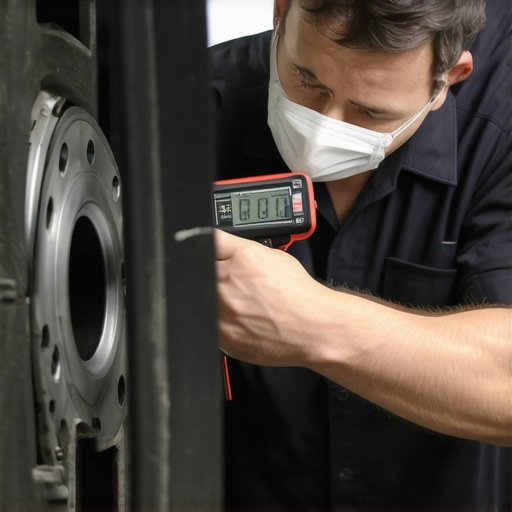
When the interface between a steel hub and an aluminum steering knuckle is compromised by galvanic corrosion, the resulting ‘rust-jacking’ does more than just seize the parts together; it creates a distorted mounting surface that guarantees premature failure. This microscopic unevenness forces the hub flange out of its intended plane, introducing lateral runout that even the most expensive replacement part cannot overcome. In the high-stakes world of vehicle diagnostics, failing to resurface the knuckle bore is a cardinal sin. If the mounting seat is not perfectly planar, the new bearing will be subjected to cyclic loading that exceeds its fatigue limit within a few thousand miles. Professionals must utilize a wire brush or specialized abrasive bits to restore the mating surface to a bright metal finish, ensuring that the clamping force is distributed equally across the entire circumference of the flange.
Why Rust-Jacked Knuckles Sabotage Your Hub Alignment
Beyond the physical fitment, the chemistry of the lubricant within the race is a specialized field that many generalists overlook. Modern hubs are typically packed with polyurea-based greases designed to withstand the extreme shear forces generated by heavy SUVs and electric vehicles. According to technical bulletins from BCA Bearings, the introduction of even a small amount of moisture or incompatible lithium-based grease can lead to ‘oil separation,’ where the base oil bleeds out of the thickener. This leaves a dry, waxy residue that cannot form the necessary elastohydrodynamic film required to separate the rollers from the race. When this film fails, the result is adhesive wear, leading to the characteristic ‘growl’ that signifies the end of the bearing’s service life. If you are noticing a change in road feel, don’t wait for a total breakdown; take a moment to record the specific frequency of the sound and share it with our technical community for a collaborative frequency analysis.
Can a Factory Seal Truly Deflect High-Pressure Road Grime?
The assumption that a ‘sealed’ unit is impervious to the environment is a dangerous misconception in auto repair. High-pressure car washes and deep-water fording can force contaminants past the outboard lip seals, especially as the rubber ages and loses its elasticity. Once grit enters the race, it acts as a grinding compound, polishing the factory-honed surfaces into a dull, pitted mess. This is why specialized car service procedures now involve checking the integrity of the CV boot and the dust shield simultaneously; a torn boot often flings grease onto the hub seal, attracting dirt that eventually abrades the seal itself. Ensuring these peripheral components are intact is the only way to guarantee the longevity of the primary bearing assembly.
Throw Away the Hammer When Seating Modern Spindles
The method of installation is often the deciding factor between a part that lasts a decade and one that fails in a month. Using a sledgehammer to ‘shock’ a hub into its seat sends high-G impact waves through the hardened steel balls and into the race, causing immediate, though invisible, indentation. This impact-induced brinelling creates ‘click’ points that will eventually grow into full-scale pits. Instead, precision-minded technicians utilize screw-type hub pullers and installers that apply a constant, linear force. This avoids the radial distortion common with impact tools and ensures that the internal clearances—often measured in microns—remain within the manufacturer’s specification. If your steering wheel feels ‘loose’ despite a new hub, it may be time to investigate why your steering wheel shakes when you hit the brakes, as this often points toward a hub flange that was warped during a violent installation process.
Advanced Diagnostic Strategies for Master Technicians
Smartphone Accelerometers as Modern Vibration Analyzers
While the seasoned ear is invaluable, modern vehicle diagnostics can be augmented by smartphone-based accelerometers to identify specific rotational frequencies. By mounting a device to the steering knuckle or strut tower, a technician can map the vibration Hz against the wheel’s RPM. If the peak frequency aligns exactly with the wheel’s rotational speed, you have a definitive mechanical signature of bearing spalling, distinguishing it immediately from higher-frequency engine vibrations or secondary drivetrain issues like transmission failures.
Why High-Performance Pads Can Accelerate Hub Decay
There is a direct correlation between braking performance and bearing lifespan that is often ignored. High-friction racing or heavy-duty ceramic pads generate significantly higher thermal loads than OEM organic pads. This heat transfers through the rotor and into the hub flange, potentially exceeding the drop point of the internal grease. If you are regularly pushing your vehicle to its limits, ensuring you have a professional car service to inspect for grease weeping at the seal is non-negotiable for maintaining assembly integrity.
The Impact of Scrub Radius on Lateral Bearing Load
When you alter a vehicle’s stance with spacers or aggressive offsets, you shift the load path from the center of the bearing race to the outer edge. This creates a leverage effect that multiplies the force exerted on the rollers during cornering. This geometric shift is a primary reason why why your steering wheel vibrates at exactly 60 mph even after a perfect wheel balance. The bearing is literally struggling to maintain its axial alignment under the unnatural leverage of the widened track.
#IMAGE_PLACEHOLDER_E#
Technical Databases for Precise Hub Repair
The Timken Interactive Damage Guide: This is the industry standard for visual identification of bearing failure modes. It provides high-resolution imagery of spalling, brinelling, and etching, allowing you to move beyond guessing and into empirical failure analysis.
BCA Bearings Video Tech Series: This resource offers deep-dives into the metallurgy of hub assemblies. It is particularly useful for technicians looking to understand the specific stresses placed on integrated ABS sensors and magnetic tone rings.
SKF Vehicle Aftermarket Portal: A comprehensive database for torque-to-yield specifications and installation procedures. Utilizing these exact measurements is the only way to avoid the premature failures that plague amateur auto repair attempts.
The Last Word on Unsprung Component Reliability
Mastering the nuances of hub assembly maintenance is a shift from reactive replacement to proactive engineering. From managing the thermal deltas between spindles to recognizing the tactile difference between tire cupping and mechanical pitting, the goal is total vehicle stability. Successfully identifying a bad wheel bearing early is as much about safety as it is about preventing a catastrophic wheel-off event. Remember that every installation shortcut, from using an impact gun on an axle nut to ignoring a stuck bolt, directly impacts the service life of the unit. We invite you to contribute your most difficult diagnostic cases to our professional community or contact our team for a deeper dive into high-performance chassis setup.