Stop Ignoring the Fluid That Keeps Your Steering Precise
While most enthusiasts and professionals prioritize regular oil changes and transmission maintenance, the power steering system often operates in a state of chronic neglect. In the realm of advanced vehicle diagnostics, we view the power steering system as a specialized hydraulic circuit that requires the same thermal and chemical stability as a modern automatic transmission. Overlooking this fluid doesn’t just lead to an annoying whine; it initiates a cycle of internal abrasion that can result in sudden, catastrophic steering failure during high-stress maneuvers.
Why Does Your Power Steering Get Stiff Only When the Engine is Cold?
Many drivers report a heavy steering feel during the first few minutes of operation, a symptom often dismissed as a quirk of cold weather. However, this is a prime indicator of fluid thickening and seal hardening. You can explore the technical nuances of why your power steering gets stiff only when the engine is cold to better understand the pressure differentials involved. When the fluid’s viscosity index fails, the pump must work exponentially harder to move the same volume, eventually leading to seal blowouts and steering rack bypass.
How Contaminated Fluid Destroys Your Rack and Pinion
Power steering fluid is not merely a lubricant; it is a force-transfer medium. Over time, the high heat generated within the pump causes the fluid to oxidize, losing its anti-foaming properties. According to technical documentation from organizations like the Society of Automotive Engineers (SAE), oxidized hydraulic fluid becomes acidic and begins to leach the plasticizers from rubber hoses and seals. This degradation introduces microscopic debris into the precision-machined valves of the steering rack, causing the “notchy” feeling that precedes total failure.
Effective auto repair requires more than just replacing parts; it involves deep-tier vehicle diagnostics to identify why a component failed. For instance, if you find metal shavings in the reservoir, the pump’s internal vanes have already begun to disintegrate. In such cases, simply swapping the rack is a temporary fix that will likely lead to another car service visit within months if the entire circuit isn’t thoroughly decontaminated.
Identify Hydraulic Failure Before It Costs Thousands
Monitoring the color and smell of the fluid is the first step in a professional-grade diagnostic routine. New fluid is typically translucent and bright, while failing fluid turns a dark, burnt brown. If you suspect your system is compromised, you should implement the exact method to flush your power steering without making a mess to extend the life of your steering components. Proactive maintenance is always more cost-effective than the labor-intensive replacement of a modern variable-assist steering system.
Professional technicians often integrate steering inspections into comprehensive car service schedules. This holistic approach ensures that the hidden world of vehicle diagnostics covers every vital system, not just the engine and transmission. Don’t wait for a total loss of assist at highway speeds—take control of your hydraulic health today.
The Hidden Link Between Alignment and Electronic Stability
Beyond the hydraulic fluid itself, the physical geometry of the steering system plays a pivotal role in vehicle safety and computer-aided handling. Many technicians successfully replace a steering rack only to find the vehicle behaves erratically or triggers dashboard warning lights at high speeds. This often happens because the steering angle sensor—a critical component of the Electronic Stability Control (ESC) system—wasn’t properly recalibrated to match the new mechanical center. If you’ve recently had work done and notice your steering wheel is off-center after a repair, you aren’t just looking at an aesthetic annoyance; you are looking at a system that thinks the car is in a permanent skid. The integration of the steering angle sensor with the anti-lock braking system means that even a minor mechanical misalignment can disrupt the predictive algorithms used for collision avoidance, leading to unexpected brake intervention or reduced engine power as the computer attempts to ‘correct’ a path that isn’t actually crooked.
Could a Simple Ground Wire Be Mimicking a Steering Pump Failure?
Modern vehicles rely heavily on Electric Power Assisted Steering (EPAS) or hybrid electro-hydraulic systems that demand massive amounts of current. An aging battery or a corroded chassis ground can cause the steering assist to drop out momentarily, especially during high-torque, low-speed maneuvers like parallel parking. Before you authorize an expensive rack replacement, you must spot a bad ground wire before it kills your new battery and your steering motor. The National Institute for Automotive Service Excellence (ASE) emphasizes that a significant percentage of ‘failed’ electronic steering components are actually victims of poor circuit integrity. Testing for voltage drop across the main steering harness should be a mandatory precursor to any mechanical teardown, as a fluctuating power supply can induce a ‘shudder’ in the wheel that feels identical to a mechanical pump failure.
The Ghost Pull That Alignment Can’t Fix
If your vehicle drifts to one side despite a perfect alignment printout, the culprit often lies deeper in the chassis components that alignment machines don’t always measure. A sticking brake caliper or a failing wheel bearing can create enough drag to simulate a steering alignment issue, pulling the vehicle toward the side with the most resistance. Expert diagnostics involve isolating these variables by monitoring hub temperatures and rotational resistance. It is essential to learn how to identify which wheel bearing is noisy while driving before the internal races become pitted enough to cause a permanent steering vibration. Often, what feels like a steering rack ‘dead spot’ is actually the early stages of a bearing seizing under load, creating lateral play that defies traditional adjustment. Similarly, if you’ve recently had work done and wonder why your car pulls to the left after a professional brake job, it’s vital to check for piston retraction issues rather than throwing more parts at the steering column.
Effective troubleshooting is about seeing the car as a unified machine where every system communicates with the next. Experienced mechanics use a ‘loaded’ test where they sweep the steering wheel from lock to lock while the vehicle is on a lift to feel for minute catches or ‘notches.’ Using the $20 scan tool that actually finds hidden transmission codes can often reveal chassis-related fault codes that never trigger a check engine light but do affect steering feedback and overall response. Have you ever chased a steering vibration that turned out to be a simple wheel bearing? Share your experience in the comments below, or suggest a topic for our next deep-dive into advanced automotive troubleshooting to help our community stay ahead of the curve.
Don’t Mistake a Faulty Torque Sensor for a Mechanical Bind
When we move into the sophisticated territory of Electric Power Assisted Steering (EPAS), the diagnostic workflow shifts from measuring fluid pressures to auditing signal integrity. The torque sensor is the heart of the modern steering column, translating the physical force you apply to the wheel into a digital command for the assist motor. If this sensor begins to drift due to internal wear or debris, it can produce a phenomenon known as ‘active nibble’ or a rhythmic shudder that many technicians misdiagnose as warped brake rotors. Unlike a mechanical bind in a universal joint, a torque sensor failure often feels ‘electric’—a high-frequency vibration that changes intensity based on the speed of your steering input rather than the speed of the vehicle. Using an oscilloscope to monitor the pulse-width modulation (PWM) signals from the steering control module is the only way to confirm if the computer is fighting your manual input due to corrupted data.

Why does my steering wheel kick back when I turn at low speeds?
This kickback, or ‘rebound’ effect, is frequently caused by a calibration mismatch within the steering control module’s software. As mechanical components like tie-rod ends and bushings age and develop minute amounts of play, the software’s ‘center-find’ algorithm may struggle to define a true zero point. This results in the motor over-correcting for small movements, creating a nervous or twitchy feeling in the driver’s hands. Before replacing expensive hardware, advanced shops often perform a ‘Soft End-Stop’ reset or a steering angle relearn procedure. This recalibration forces the module to re-map the physical limits of the rack, often eliminating the kickback and restoring the smooth, weighted feel of a factory-new system. If these digital corrections fail, you must then inspect the internal torsion bar for microscopic fractures that can occur after a significant pothole impact or curb strike.
Air is the Enemy of Every Hydraulic Steering Rack
For vehicles still utilizing traditional hydraulic or electro-hydraulic setups, the presence of air in the lines—known as aeration—is a silent performance killer. Unlike hydraulic fluid, air is compressible; when it enters the high-pressure side of the circuit, it acts like a spring, absorbing the force that should be moving your wheels. This leads to a ‘spongy’ steering response and the characteristic groaning noise during full-lock maneuvers. According to the technical service standards provided by ZF Friedrichshafen AG, even a microscopic leak on the suction side of the pump can draw air into the system without ever leaking fluid out. This creates a vacuum-induced foam that bypasses the reservoir’s internal baffles and prevents the fluid from cooling properly, leading to localized overheating of the pump’s internal vanes. If you notice tiny bubbles on your dipstick after a drive, a simple fluid top-off won’t fix the issue; you need to identify the failing O-ring or porous suction hose that is compromising the vacuum seal.
Diagnosing these edge cases requires a shift from ‘part-swapping’ to ‘system analysis.’ Many enthusiasts get frustrated when a new pump doesn’t fix a steering whine, failing to realize that the reservoir’s internal filter might be clogged or that an aftermarket hose has a diameter that is causing turbulent flow. If you are struggling with a persistent vibration that defies standard alignment, it might be time to look at the variable-effort solenoid—a component that adjusts steering weight based on vehicle speed. When these solenoids stick, they can trap high pressure in the rack at highway speeds, making the vehicle feel ‘darty’ and over-responsive. Have you ever encountered a steering ghost that only appeared at specific temperatures? Documenting these variables is the key to cracking the case in the garage.
The Internal Relief Valve That Can Kill Your Pump
While most mechanics look at the pump as a single unit, the internal pressure relief valve is the true gatekeeper of system longevity. This tiny, spring-loaded component is designed to bypass fluid when pressures exceed safe limits, such as when you hold the wheel at full lock. However, microscopic metallic debris can cause this valve to stick in a partially open position. When this happens, the system cannot maintain the necessary pressure for low-speed assist, leading many to incorrectly replace the entire pump. A seasoned diagnostic technician uses a high-pressure gauge with a shut-off valve to perform a ‘dead-head’ test, isolating the pump’s internal efficiency from the rest of the steering circuit. If the pump can’t hit its rated PSI against a closed valve, the internal bypass is failing, rendering even the cleanest fluid useless.
Why does mixing synthetic and mineral fluid cause seal swelling?
The chemical composition of steering seals is precisely matched to the base oil of the recommended fluid. Modern vehicles often require highly specific synthetic blends with proprietary additive packages. When a generic ‘universal’ fluid or an older mineral-based oil is introduced, the elastomers in the seals can react negatively. According to technical specifications from Bosch Mobility, incompatible fluids can cause seals to swell by as much as 15% or, conversely, shrink and harden. Either scenario leads to internal bypass within the steering rack, where high-pressure fluid leaks past the piston seals and into the low-pressure side. This creates a ‘lazy’ steering feel where the vehicle requires significantly more effort to turn in one direction than the other, a nuance often missed during a standard car service.
Keep the Dust Out or Watch Your Rack Scour from the Inside
The humble rubber bellows, or rack boots, are the only line of defense for the precision-ground surface of your rack-and-pinion. Once a boot tears, it acts like a vacuum, sucking in road salt, grit, and moisture every time you turn the wheel. This debris embeds itself into the internal seals, effectively turning them into sandpaper. As the rack slides back and forth, it develops deep scores that no amount of new fluid can fix. 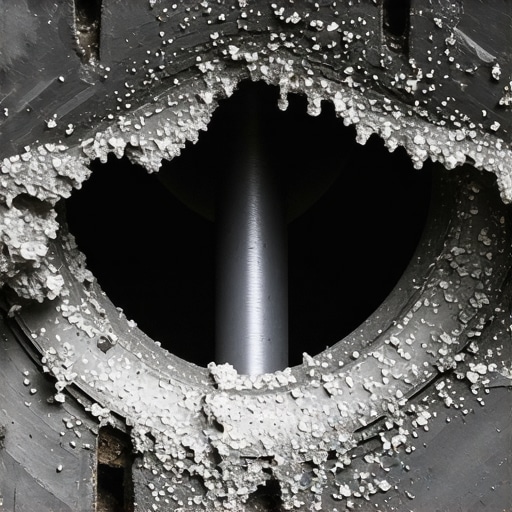 Professional vehicle diagnostics should always include a tactile inspection of these boots; if they feel brittle or show signs of oil sweating, the clock is ticking on your steering rack. Replacing a twenty-dollar boot today can save you a fifteen-hundred-dollar rack replacement next season.
Stop Chasing Vibrations That Start in the Steering Column Dampener
When a steering vibration persists after balancing tires and checking wheel bearings, the focus must shift to the steering column itself. Many modern luxury and performance vehicles utilize a rubber-isolated steering coupler or a fluid-filled dampener within the column to filter out road harshness. Over time, the rubber degrades or the fluid leaks, allowing engine harmonics and minor tire imperfections to travel directly to the driver’s hands. This ‘phantom vibration’ is frequently misdiagnosed as a warped rotor or a bad CV joint. Expert auto repair involves disconnecting the steering shaft and checking the dampener for excessive play or ‘slop’ that shouldn’t be there. If you’ve replaced everything else and the wheel still shakes at 65 MPH, it is time to audit the column’s physical isolation mounts. Have you ever struggled with a steering shake that wouldn’t go away? Tell us about your diagnostic journey in the comments below, or reach out to see how specialized tool-sets can reveal these hidden mechanical flaws.
Expert Insights & Advanced Considerations
Don’t Trust the Dipstick: Use Thermal Delta Analysis
Seasoned technicians know that fluid color is only half the story. To truly master vehicle diagnostics, you should use an infrared thermometer to measure the temperature differential between the pump outlet and the reservoir return line. A delta exceeding 20 degrees Fahrenheit often indicates internal bypass or excessive friction within the rack, suggesting that even if the fluid looks clean, the mechanical components are under extreme stress. This level of deep-tier vehicle diagnostics allows you to predict failure long before a pump starts to groan.
The Digital Ghost in Your Steering Column
If you have addressed every mechanical variable and still experience a vibration, it is time to audit the Electronic Power Steering (EPS) software. Modern systems use ‘Active Dampening’ algorithms to mask road vibration. When these sensors drift, they can actually induce a shudder. This is often the real reason why your steering wheel shakes at 60 mph but stops at 70. Recalibrating the torque sensor offset via a high-end scan tool can frequently solve ‘unfixable’ vibrations without a single wrench turn.
Why Chemical Compatibility is Non-Negotiable
The elastomers used in modern steering seals are high-performance polymers that are sensitive to pH changes. Using the wrong fluid doesn’t just cause a leak; it causes the seals to lose their ‘memory,’ preventing them from sealing correctly against the rack shaft under high pressure. Before you assume you need a new rack, perform a chemical flush to remove incompatible additives. In many cases, restoring the correct fluid chemistry can stop minor ‘seeping’ and help you identify a failing wheel bearing before the hub seizes up by eliminating the ‘background noise’ of a struggling hydraulic system.
Where the Pros Go to Solve Impossible Chassis Problems
IATN (International Automotive Technicians Network): This is the premier destination for peer-reviewed case studies where real-world mechanics share the ‘impossible’ fixes that standard manuals miss. It is essential for understanding complex steering geometry failures.
ZF Friedrichshafen Technical Portal: As an OEM manufacturer for many high-end steering systems, ZF provides granular data on internal tolerances and fluid specifications that you won’t find in generic auto repair guides.
ASE Advanced Level (L1) Specialist Study Guides: Even if you aren’t seeking certification, these resources offer a masterclass in interpreting electrical waveforms and signal logic for electronic steering systems.
Final Word: Your Path to Perfect Handling
Achieving a factory-fresh steering feel requires a shift in perspective. You must view the steering system not as a collection of isolated parts, but as a balanced hydraulic and electronic circuit. Whether you are dealing with a car service professional or performing the work yourself, always prioritize data over guesswork. From checking a hidden ground wire that causes intermittent starting issues and steering dropouts to auditing pump pressures, the details define the outcome. Take the time to diagnose the root cause, and your vehicle will reward you with the precise, effortless handling it was designed to deliver.