That momentary, high-pitched chirp when the light turns green and you press the accelerator isn’t just an annoyance; it is a diagnostic signal of a system under transient stress. In the world of auto repair, noises occurring at the exact moment of load transition—from a standstill to motion—point toward components struggling with the sudden torque demand. This acoustic signature often indicates a disparity between the rotational speed of a pulley and the drive belt, or perhaps a more sinister misalignment within the transmission assembly. Professional vehicle diagnostics require moving beyond simple observation to understanding the physics of friction and belt slip. By identifying the specific frequency and duration of these sounds, an expert can pinpoint whether the issue lies within the accessory drive system or deeper within the drivetrain architecture.
Why a Quick Squeak Often Signals Serpentine Belt Fatigue
The serpentine belt is the workhorse of your engine compartment, responsible for powering everything from the alternator to the power steering pump. When you accelerate from a stop, the engine’s crankshaft suddenly increases its rotational velocity. If the belt has lost its elasticity or the ribbing has glazed over, it cannot maintain the necessary grip on the pulleys. This brief loss of traction results in the audible chirp many drivers experience. Utilizing the hidden world of vehicle diagnostics, technicians can measure belt tension and surface integrity to determine if a simple replacement is necessary. Modern EPDM belts rarely crack like older neoprene versions; instead, they lose material in a way that is nearly invisible to the untrained eye but highly detrimental to performance.
Is Your Belt Tensioner Losing Its Grip?
A common inquiry among automotive enthusiasts involves why a new belt might still produce a chirp. The answer often lies in the automatic belt tensioner. This component uses a heavy-duty internal spring to maintain a constant load on the belt. Over time, the internal damping mechanism fails, allowing the arm to vibrate or ‘chatter’ under load. This oscillation reduces the effective friction between the belt and the pulleys. According to technical data from the Society of Automotive Engineers (SAE), even a 5% reduction in tension can lead to significant slip during high-torque events. Mastering top auto repair techniques involves checking the tensioner’s alignment and range of motion, as a misaligned pulley will cause the belt to edge-wear and eventually fail prematurely.
Drivetrain Harmonics and the Transition of Power
While belts are the most frequent culprits, the noise could also originate from the transmission or the motor mounts. If the chirp sounds more like a metallic click or a sharp squeak, it may be the result of excessive play in the U-joints or a failing CV axle. When torque is applied, these components must pivot and rotate simultaneously; if the internal lubrication has dried out, the metal-on-metal contact creates a distinct sound. Furthermore, internal issues such as a worn torque converter clutch can manifest as a shudder or chirp during the initial engagement phase. Analyzing transmission failures decoded helps in distinguishing between external accessory noises and internal mechanical distress that could lead to catastrophic failure if left unaddressed.
If you have noticed these symptoms, do not wait for a breakdown; schedule a professional car service to ensure your vehicle remains reliable and safe for the road ahead.
Preventing Damage Before Components Fail Completely
Ignoring a chirp is a gamble with your vehicle’s longevity. A slipping belt generates immense heat, which can damage the bearings in your alternator, water pump, and AC compressor. What starts as a $50 belt issue can quickly escalate into a multi-thousand-dollar repair bill if a pulley seizes or the belt snaps and takes out a plastic cooling fan or wiring harness. Proactive maintenance is the cornerstone of mechanical reliability. By addressing the root cause of the chirp—whether it is a contaminated belt, a weak tensioner, or a drivetrain misalignment—you preserve the operational integrity of the entire vehicle. Expert technicians use specialized tools like laser alignment gauges and sonic tension meters to ensure every component is within factory specifications, providing peace of mind that a simple visual inspection cannot offer.
Watch Out for Engine Mounts Shifting Under Pressure
While a belt chirp is a common diagnostic starting point, the underlying cause might be more structural than a simple piece of rubber. Engine and transmission mounts are engineered to absorb the massive torque reaction generated when you press the accelerator. When these mounts degrade, the entire powertrain can tilt significantly under load. This sudden shift in geometry can pull a serpentine belt out of its natural alignment for a fraction of a second, resulting in a momentary squeal that sounds exactly like a worn belt. If you have noticed why your engine stumbles when you accelerate the 20 spark fix, it is worth examining the rubber isolation blocks for cracks or fluid leaks. A failed mount doesn’t just create noise; it increases the stress on every hose, wire, and drivetrain component connected to the engine block.
The Ghostly Hiss Often Mistaken for a Mechanical Squeal
Not every high-pitched sound originates from a rotating pulley. When you accelerate, the throttle plate opens wide, causing a drastic change in intake manifold pressure. A pinhole leak in a vacuum hose or a cracked plastic intake plenum can produce a sharp, whistling hiss that mimics a mechanical chirp. This is particularly common in modern turbocharged vehicles where boost pressure can force air out of a failing gasket. According to the Car Care Council, an organization dedicated to consumer automotive education, nearly 25 percent of cars on the road have low or contaminated fluids or minor air leaks, which frequently contributes to transient engine noises during acceleration. To rule this out, you can stop your engine from dying at stoplights with this 14 vacuum leak fix by inspecting the secondary air lines and intake boots for signs of brittleness. 
Could a Dirty Sensor Be Mimicking a Mechanical Slip?
It is a question that often puzzles DIY mechanics: can an electronic failure cause a physical sound? The answer is a resounding yes. A contaminated Mass Air Flow (MAF) sensor or a lagging Throttle Position Sensor (TPS) can cause the engine’s ECU to miscalculate the required fuel trim during rapid acceleration. This results in a momentary lean condition, causing a subtle engine stumble or a “lean pop” in the intake manifold. To the driver, this might feel like a transmission slip or sound like a belt chirp. If you find why your engine stumbles at red lights and the 14 sensor fix, you are likely looking at a sensor that is sending slow data to the computer. Before replacing expensive mechanical parts, consider cleaning your sensors and checking for stored diagnostic trouble codes.
Stop Ignoring the Shudder in Your Shift
In many front-wheel-drive vehicles, what sounds like a chirp from the front end is actually the early warning sign of a torque converter clutch struggling to engage. This internal transmission component relies on precise hydraulic pressure and fluid friction modifiers to lock up smoothly. As fluid breaks down, it loses its ability to manage the transition from hydraulic drive to mechanical lock, leading to a “shudder” or a brief high-pitched friction noise. You can often stop that transmission shudder for good with this 18 filter change and fresh high-quality fluid. Have you ever experienced a noise that only happens on the first shift of the morning? Share your symptoms in the comments below or read more about transmission troubles how to save time and money with proven repairs to see if your vehicle fits the profile for a simple fluid service rather than a full rebuild. If you are technically inclined, learning how to pull engine fault codes using only a paperclip can provide the data needed to confirm if the transmission electronics are the root of the problem.
Why the Crankshaft Pulley’s Rubber Core Matters
Precision in vehicle diagnostics often requires looking past the belt itself to the components that drive it. The harmonic balancer, or crankshaft vibration damper, is a critical piece of hardware often overlooked during a standard car service. This component consists of an inner hub and an outer pulley ring bonded together by a thick layer of rubber. As this rubber ages and undergoes thousands of thermal cycles, it can lose its bond. Under the sudden torque of acceleration, the outer ring momentarily slips against the inner hub, producing a chirp that is indistinguishable from a belt squeal to the untrained ear. If the slip becomes severe, it can throw off the engine’s timing marks or even cause the outer ring to fly off, leading to catastrophic engine damage. Identifying this requires a ‘scribe test,’ where a technician marks a straight line across the hub and ring; if the marks no longer align after a drive, the balancer must be replaced immediately to prevent crankshaft snapping or accessory drive destruction.
How do I know if my alternator pulley is failing?
Many modern engines utilize an Overrunning Alternator Pulley (OAP) or an Overrunning Alternator Decoupler (OAD). These specialized pulleys allow the alternator to ‘freewheel’ when the engine speed suddenly drops, preventing the massive inertia of the alternator rotor from snapping the belt or causing excessive flutter. When the internal one-way clutch or spring mechanism inside these pulleys begins to seize, it creates a sharp chirp during rapid RPM changes or even at idle. 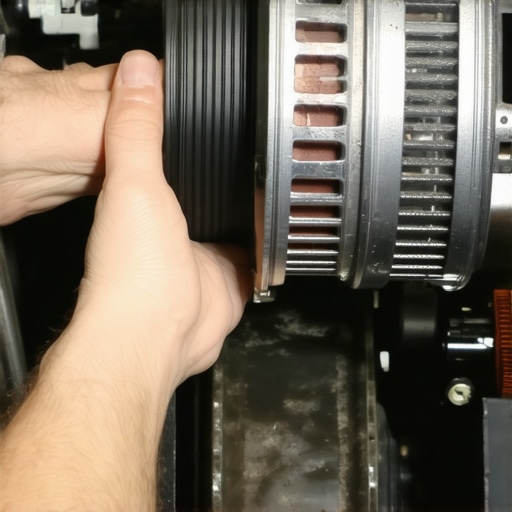 According to technical bulletins from the Gates Corporation, a seized OAD can increase belt tensioner vibration by up to 10 times, drastically shortening the life of every accessory component in the system. Diagnosing this requires removing the belt and ensuring the pulley spins freely in one direction but locks in the other. If you feel a vibration through the steering wheel while stopped in gear, your OAD pulley might be the silent culprit behind those intermittent chirps.
Exhaust Manifold Leaks That Mimic Accessory Noise
Sometimes, the ‘chirp’ isn’t mechanical friction at all, but rather high-velocity gas escaping a confined space. Exhaust manifold bolts, particularly on modern aluminum-head engines, are prone to snapping due to the different expansion rates of the cast iron manifold and the cylinder head. When you accelerate, the increased exhaust volume and pressure force air through the tiny gap left by a broken stud or a warped flange. This creates a high-frequency vibration or ‘chirp’ that often disappears once the engine reaches full operating temperature and the metal expands to seal the leak. Differentiating this from a transmission or belt issue requires a smoke test or a visual inspection for carbon soot tracks around the exhaust ports. Expert auto repair professionals often use an ultrasonic leak detector to pinpoint these sounds that are otherwise masked by the engine’s combustion noise. If you suspect your vehicle is suffering from these complex symptoms, checking the alignment of your drive components with a laser tool is a vital step in high-end maintenance. Before you commit to a full manifold replacement, consider the role of the EGR valve and its associated piping, as a cracked corrugated EGR tube can produce a nearly identical whistle under load.
While mechanical friction is the most intuitive culprit, the fluid dynamics within your fuel system can also produce deceptive acoustics. High-pressure fuel rails in modern GDI (Gasoline Direct Injection) engines utilize pulsation dampers to smooth out the rapid-fire opening and closing of injectors. When these dampers fail or lose their tuning, the sudden surge in fuel demand during acceleration creates a hydraulic shockwave. This resonance can manifest as a high-pitched tink or a series of rapid chirps that vibrate through the metal lines. Distinguishing this from a transmission chirp requires a tactile inspection; a technician can often feel the vibration in the fuel line while the engine is under load on a dynamometer. This level of vehicle diagnostics separates the general mechanics from the specialists who understand the intricate interplay of fluid physics and mechanical vibration.
Watch for the High-Frequency Whistle of a Ruptured Diaphragm
A common but frequently misdiagnosed source of a transient chirp is a failing PCV (Positive Crankcase Ventilation) oil separator. In many European and modern domestic engines, the PCV system uses a delicate rubber diaphragm to regulate crankcase pressure. When this diaphragm develops a hairline tear, the pressure differential changes instantly as you tip into the throttle. The resulting air leak creates a whistle that perfectly mimics a slipping serpentine belt.  Professional auto repair shops often use a smoke machine to pressurize the intake tract, revealing these hidden leaks that only appear under specific vacuum conditions. If you ignore this whistle, the resulting lean condition can lead to fuel trim errors and a decrease in fuel economy.
Can a failing water pump bearing mimic a transient belt slip?
Yes, and it is a diagnostic trap that often leads to unnecessary belt replacements. A water pump bearing is under constant tension from the serpentine belt. As you accelerate, the increased rotational speed puts a higher lateral load on the internal bearings. If the bearing races are pitted or the lubrication has escaped through a failing seal, the bearing will chirp as it struggles to maintain its axis of rotation. This sound is almost identical to a belt chirp but usually possesses a more metallic, rhythmic quality. According to technical guides from Aisin World Corp of America, a global leader in OE automotive components, early detection of water pump bearing noise is crucial, as a total failure can result in immediate engine overheating and potential head gasket damage.
Why You Should Trust the Data From Electronic Stethoscopes
When visual inspections and traditional listening sticks fail, elite technicians turn to multi-channel electronic stethoscopes, often referred to as ChassisEAR systems. These tools allow a technician to clip sensors onto multiple components—such as the transmission bellhousing, the alternator bracket, and the AC compressor—and listen to the live feedback while the vehicle is actually in motion. This eliminates the guesswork of trying to replicate a load-dependent chirp in a stationary bay. By isolating the exact source of the frequency, you avoid the parts cannon approach to car service. If your vehicle produces a sound that only occurs during uphill acceleration, this advanced diagnostic method is the only way to ensure the repair is performed correctly the first time.
Check the Hidden Impact of Tensioner Arm Pivot Wear
Even if the tensioner spring remains strong, the pivot point where the arm attaches to the engine block can develop excessive play. Under the transient torque of a green-light acceleration, the arm can cock slightly to the side, causing the belt to track across the pulley at an angle. This misalignment creates a momentary side-load chirp as the belt ribs fight to center themselves in the grooves. Detecting this requires observing the tensioner arm’s tracking path with a strobe light or high-speed camera, as the movement is often too fast for the human eye to perceive. Addressing these structural nuances is what ensures a long-term fix rather than a temporary silence.
Do not let a mysterious noise turn into a roadside emergency. Ensure your vehicle receives the specialized attention it deserves by booking an appointment with a diagnostic expert who utilizes advanced acoustic analysis tools.
Expert Insights & Advanced Considerations
How Humidity Changes the Friction Coefficient of Your Belt
Environmental factors play a massive role in transient noises. High humidity can actually act as a temporary lubricant on an EPDM belt, masking a slip that becomes audible only as the rubber dries out. If your chirp is weather-dependent, it’s a clear indicator of surface glazing. Utilizing top auto repair techniques, you can identify if the belt’s rib profile is actually deep enough to displace contaminants or if it’s simply sliding over the pulley surface.
Why Decoupler Pulleys Often Hide the Real Problem
An alternator decoupler pulley is designed to soak up crankshaft vibrations, but when it fails, it transfers that energy directly into the belt. This creates a chirp that looks like a bad tensioner but is actually a rotational inertia issue. A thorough car service should always include a check of the OAP/OAD overrun function to prevent systemic failures.
Fluid Viscosity and Cold-Start Chirps
Sometimes the noise isn’t the belt at all, but rather the internal hydraulic response of the gearbox. If the sound only happens when the vehicle is warming up, check why your transmission shudders when cold and the 12 solution to see if fluid thickness is preventing proper clutch engagement. #IMAGE_PLACE_FINAL#
Curated Expert Resources
Gates Corporation Knowledge Center: The definitive guide for serpentine drive systems and EPDM belt wear analysis. This is essential for understanding rotational dynamics and pulley alignment.
Society of Automotive Engineers (SAE) Technical Papers: High-level research on drivetrain harmonics and the physics of belt-to-pulley friction coefficients for those wanting to dive into the engineering data.
IATN (International Automotive Technicians Network): A peer-to-peer resource where master techs share real-world case studies on rare diagnostic ghosts and complex electronic failures.
Final Expert Perspective
Navigating the complexities of high-pitched noises during load transitions requires more than just a keen ear; it demands a systematic approach to vehicle diagnostics. Whether the root cause is a microscopic crack in a vacuum line, a failing transmission torque converter, or a simple belt misalignment, addressing the issue early prevents the domino effect of mechanical failure. High-quality auto repair is about precision and data-driven decisions. By understanding transmission failures decoded and accessory drive mechanics, you ensure your vehicle stays efficient and reliable. If you have encountered unique symptoms or have solved a stubborn chirp with an unconventional fix, we invite you to share your findings to help others master the art of automotive maintenance.